
Austin Pendleton’s fascinating, lively backstage comedy-drama Orson’s Shadow, now enjoying a new run at Manhattan’s Theatre for the New City, brings four iconic actors back to the stage again– a place, few would disagree, where those actors likely have always felt most alive to begin with. The first setting of Pendleton’s play is The Gaiety Theater in Dublin in 1960, and the actors are… (Get ready!) Orson Welles (Brad Fryman), Laurence Olivier (Ryan Tramont), Joan Plowright (Cady McClain), and Vivien Leigh (Natalie Menna). In previous runs, Orson’s Shadow had won the Drama League Award for Distinguished Performance, and had received a Lucille Lortel Award nomination for Outstanding Play. Critical accolades notwithstanding, Orson’s Shadow arguably had its audience appeal already cut out for it from the start: To see the four aforementioned legends of stage and screen reincarnated in 2024 is a thrill for the audience from the get-go. That thrill is bolstered by the zesty performances of the cast. Here’s an example: Modern audiences who have been used to seeing actress Joan Plowright (now 95) playing eccentric old ladies and grandmothers will now get to see a younger, earthy version of the actress, complete with short skirt and sexy, sassy attitude. Fryman, Tramont, McClain, and Menna really give their characters all they’ve got, matching their own energy levels to the reportedly over-the-top, and often tempestuous, personalities of the larger-than-life stars they are playing. Not to be outdone, Patrick Hamilton plays Ken Tynan, a chain-smoking and chain-coughing theater critic who is Orson’s long-suffering frenemy but also the star’s most hopelessly devoted admirer. Ken, who often gets to speak directly to the audience, has the goal to bring Welles and Laurence Olivier together, creatively, for an upcoming production of the Eugene Ionesco’s idiosyncratic play Rhinoceros at the Royal Court Theatre in London. Rounding out the cast of six actors is the charming Luke Hofmaier as Sean, Welles’ young (and, all together now: “long-suffering”…) stage manager/assistant who wasn’t even born yet when Citizen Kane was released. In addition to fetching and carrying, Sean also briefly becomes the target of a manic Vivien Leigh’s affections later in the play.
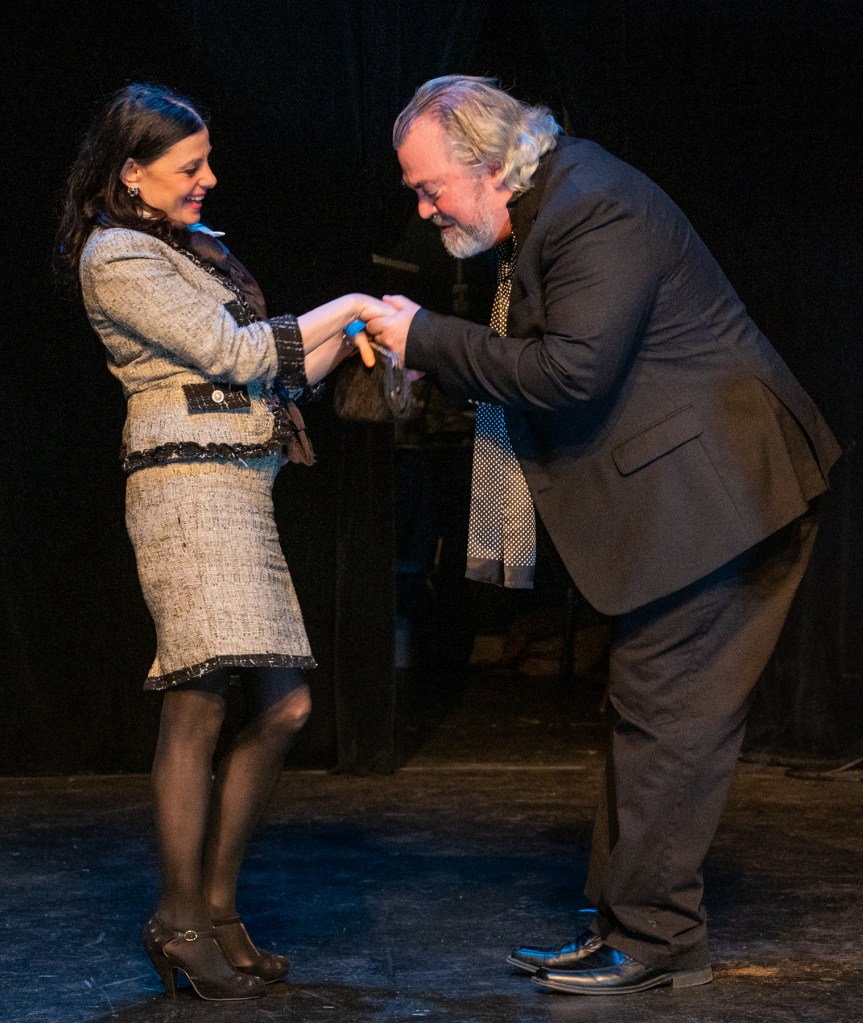

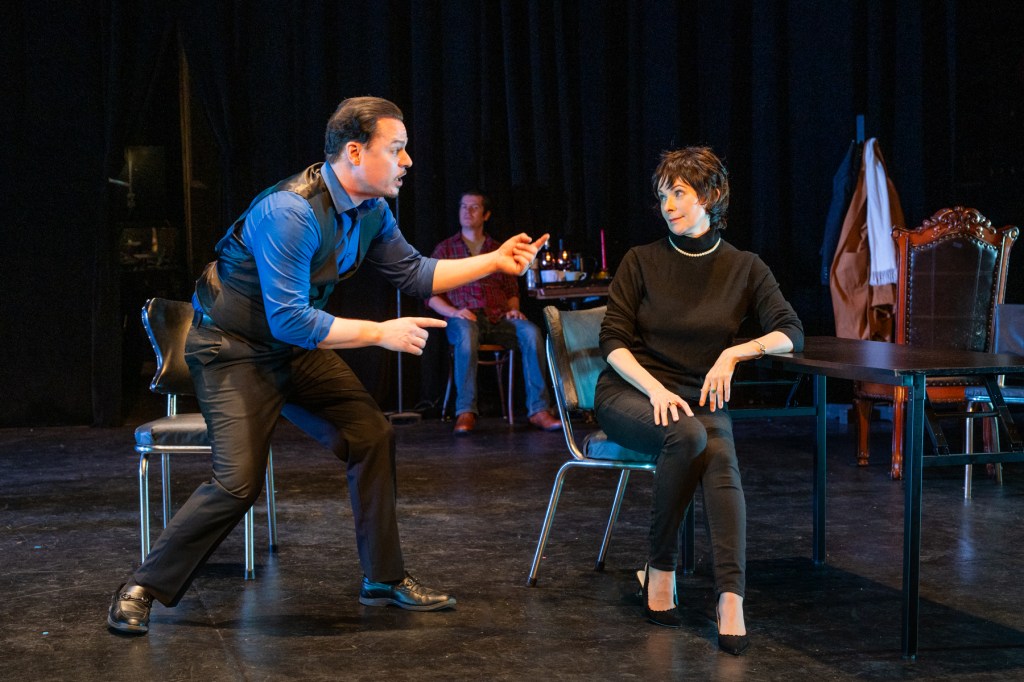

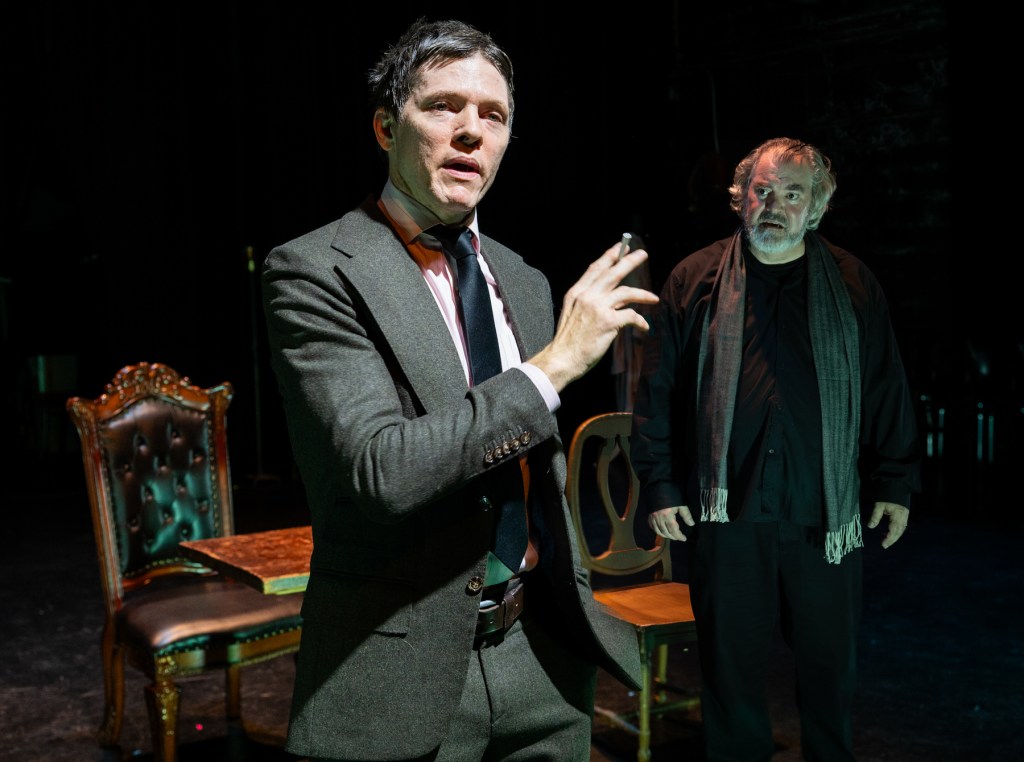
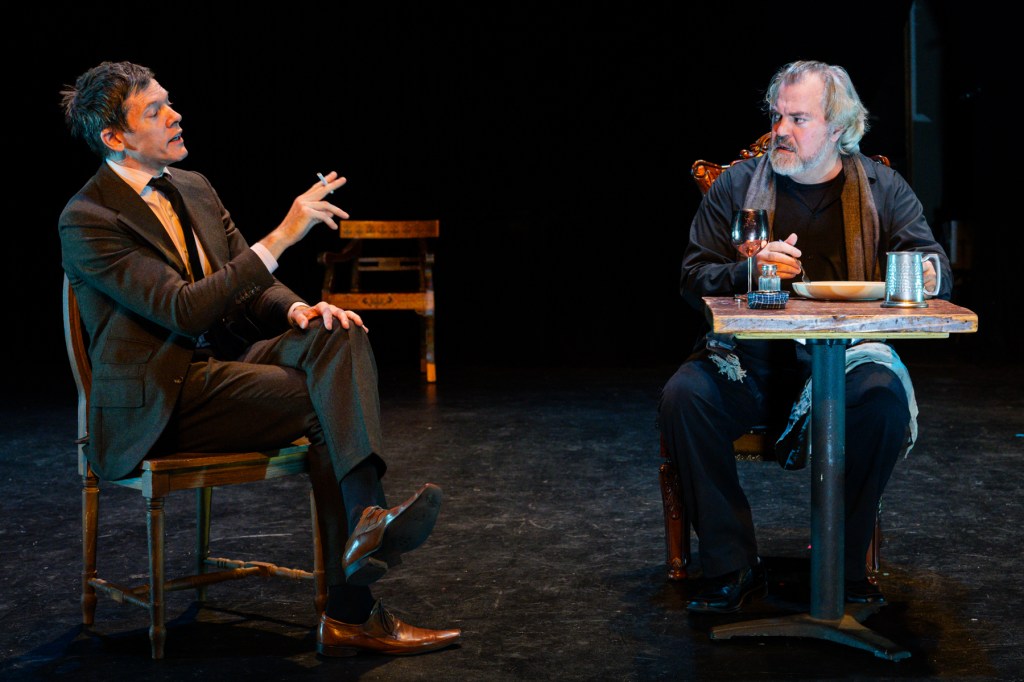

But back to “larger-than-life”… Brad Fryman is perfect as Orson Welles, the American director and actor whose transgenerational legacy on pop culture can never be overestimated. (The Orson in this play, incidentally, would wholeheartedly agree…) Welles, in all his blustery yet undeniably charismatic glory, is concerned that the best of his creativity may be behind him. At one point he declares, “Hollywood has not known who I am since 1948.” He is having a hard time raising money for his next movie. Welles is also quick to frequently remind the audience, “Olivier destroyed me in Hollywood. Did you know that?… Never mind. I’m not going into details, but he destroyed me in Hollywood in 1948.” Surely enough, the audience soon gets to meet the “dashing” Laurence/Larry Olivier (Ryan Lamont) in the play’s second act, who the character Ken refers to as “the greatest actor in the English-speaking world”. (Mr. Olivier himself would eagerly make that claim as well…). Personally, Olivier is in a declining marriage with the emotionally fragile Vivien Leigh and is moving towards an intimate and creative relationship with Joan Plowright. (The two would marry in 1961.) Like Orson Welles, Olivier’s talent is unquestionable. But could these two men keep their over-the-top personalities in check to work together creatively?
Speaking of Vivien Leigh: The character is only rarely seen in the beginning of the play, although she is often spoken about by her husband Laurence Oliver, usually in regard to the actress’ famous bipolar disorder (known back then as “manic depression”). However, Ms. Leigh reappears in a big way for the play’s third act, showing up to watch the first rehearsal for Rhinoceros. As Leigh, Natalie Menna expertly plays the challenging role of a person who initially comes across as charming, alluring, and funny, but who slowly becomes intimidating and off-putting as her mania slowly escalates. Leigh even jokes about her illness at the beginning of the episode, saying things like, “I’m getting to the point in the mania where I become unpleasant, and I don’t want that to happen ’til I’m on the plane, where I can assault a stewardess or something!” Later, she tells Welles, “The depression that comes after this one, the electric shock they’re going to have to give me in New York is going to turn the lights off all over the West Side, it’ll be the most terrifying thing since your Martians landed in New Jersey…” The actress’ situation only gets worse. Still, Ms. Leigh is definitely not the only character to suffer some type of breakdown during the play’s climax, where Welles and Olivier finally go eye to eye and ego to ego…
Funny, fascinating, and very respectful to its real-life characters, Austin Pendleton’s Orson’s Shadows explores many aspects of show business– many of which, it seems, haven’t changed much since 1960. This includes the highs and lows of being a celebrity, being part of a business that doesn’t always recognize talent, and how quickly a famous person can be forgotten by the public. Cinephiles and theater lovers will undoubtedly appreciate the play’s many, many smart and funny cinematic and theater references. Most provocatively, the audience learns that for all these famous names in the play, the most challenging role for them may very well have simply been the role of being a performer.
Orson’s Shadow is highly recommended.
Orson’s Shadow is directed by Austin Pendleton and David Schweizer. Lighting Design is by Alexander Bartenieff. Costume Design is by Billy Little. Sound Design is by Nick T. Moore. Additionally produced by Mark Karafin. The play continues through December 1, 2024, on Tuesday, Wednesday, Thursday, Friday, Saturday at 8:00 PM, Saturday at 2:00 PM, Sunday at 3:00 PM. There is no performance on Thursday, November 28 (Thanksgiving) or Saturday, November 30. Tickets: $25, Students & Seniors $18 Tuesdays, pPay What You Can, Runtime is 2 hours with one 15-minute Intermission. Theater For the New City is located at 155 First Ave, New York City. Visit Orson’s Shadow (Nov 2024) – Theater for the New City for more information.
Photos by Russ Rowland
 LAVENDER AFTER DARK (because life begins when the sun goes down...)