
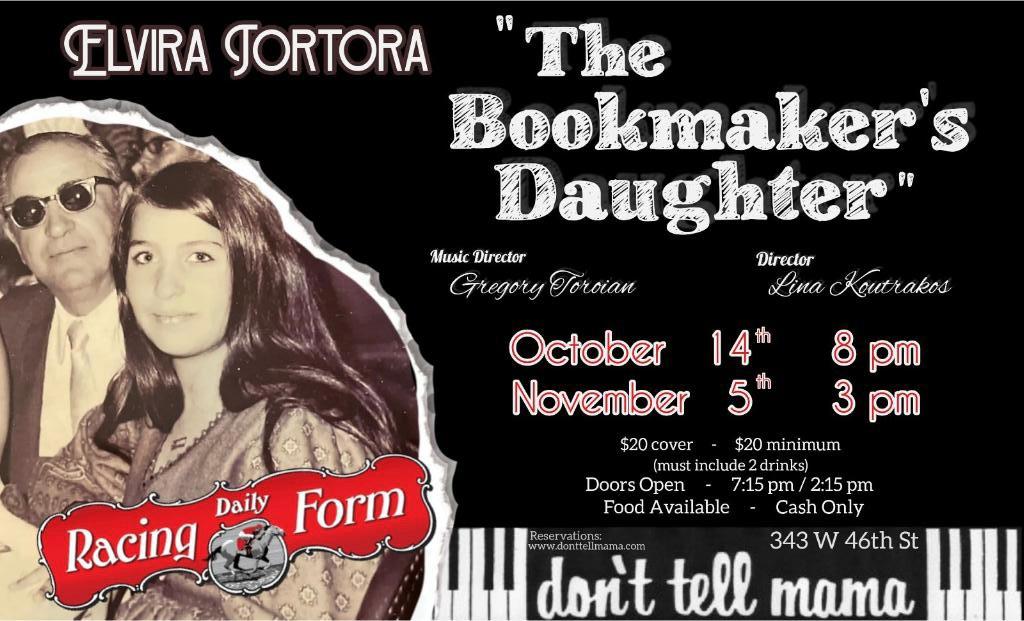
Elvira Tortora’s delightful one-woman show, The Bookmaker’s Daughter, is patently and proudly biographical. But this lovely singer’s highly anticipated cabaret debut is not just HER story. Through Tortora’s personal anecdotes and her “primo” selection of songs, The Bookmaker’s Daughter also becomes a vivid recreation of a very specific time, place, and culture in American history: The scent of nostalgia in the air couldn’t be any thicker. One example of many is when Tortora reminisces about her 13th birthday party at the iconic Latin Quarter in Manhattan; Bobby Vinton (!) performed that night. A baby boomer, she grew up in a well-off, traditional Italian-American Brooklyn household, enjoying a “terrific” childhood with a devoted mother and father. Mama was a full-time homemaker. But before we go any further: Tortora’s father didn’t exactly “make books” as the name of her show suggests. Early on, via hilarious references (“that occasional trip for business” to Vegas or Miami) and such juicy tidbits like “Except for the New York Daily News, the most read and studied piece of literature in our home was the daily racing form!”, we learn that Papa was involved in, uhm… “another” business. (Have you guessed yet?) Let’s just say that there was nothing odd about her father counting large stacks of cash on the kitchen table, or expensive items like a mink coat or a color TV suddenly showing up in the home. It’s no mystery why Tortora chose the Frank Loesser classic Luck Be a Lady as one of the numbers for the “soundtrack” of her family life; “numbers”, apparently, were VERY important.
To restate the obvious, Elvira Tortora has a unique story to tell: a story full of heritage, humor, heart, and happy endings. The stage, particularly the intimate space of Manhattan’s cabaret hotspot Don’t tell Mama, seems to be Tortora’s perfect conduit to tell that story. In The Bookmaker’s Daughter, Elvira has picked a fine selection of songs to set her personal saga to music. I’m All I’ve Got, from the musical Bravo Giovanni, becomes a lively anthem for post-divorce empowerment… Later on, Stephen Sondheim’s Marry Me a Little becomes one of the most brilliant and honest songs about finding love “the second time around”. Tortora honors the important people in her life with their own songs: She sings One of the Great Ones, from the musical A Bronx Tale, in honor of her parents’ courtship. The lush classic Blue Velvet gets dedicated to her mother’s inner and outer beauty. The touching With So Little to Be Sure Of becomes a musical tribute to her enduring relationship with her sister. But one of the most affecting moments of the afternoon came with Dance with My Father, made extremely popular by Luther Vandross. It was impossible to find a dry eye in the house during that song.
Tortora’s Italian-American heritage and upbringing colored every aspect of her story. She even sang some of lyrics in Italian. Even audience members who don’t speak what’s considered “the most romantic language in the word” will understand lyrics like “Amore baciami, arrivederci amore baciami”. Indeed, the show at times seemed patently created as a love letter to her family and childhood friends, who showed up in great numbers for her October 29th show. Often, shows that are TOO personal can run the risk of seeming overly precious. Tortora’s show transcends that; The Bookmaker’s Daughter becomes a universal message about love, faith, family, and self-acceptance., regardless of our age or ethnicity.
The Bookmaker’s Daughter may have been Tortora’s nightclub debut, but the audience would never have known. She has seemingly unflinching confidence, natural charm, and stage presence. She wasted no time in hitting those grand notes with the very first number, My Love, Forgive Me (Amore, Scusame), a song introduced to America by Robert Goulet. Elvira described the song as “having it all”. The way she sings it, it indeed does. While so many cabaret artists make it a point to push beyond the borders of their natural voices, Elvira instinctively knows her own range– and, to put it simply, she sings the hell out of it. An example of this is Raining, an underappreciated gem from Rocky, the Musical. On the surface, it’s just a pleasant song. But Tortora transforms it into yet another musical highlight of the show.
The Bookmaker’s Daughter brings its audience us back to an idealized era where decades-old traditions were trying to stay alive amidst an ever-changing world outside of tight-knit Brooklyn neighborhoods. That said, Elvira Tortora’s musical message about staying true to oneself is timelier and more relevant than ever as we approach 2024. Let’s hope she continues to share her stories– as well as to create new ones.

Elvira Tortora’s The Bookmaker’s Daughter, directed by Lina Koutrakos with Musical Direction by Gregory Toroian, continues on Sunday, November 5th at 3PM at Don’t Tell Mama, 343 W. 46th St., New York City. Visit http://www.DontTellMamaNYC.com for more information.
 LAVENDER AFTER DARK (because life begins when the sun goes down...)
[…] community, including Aaron Lee Battle, Karen Mack, Sue Matsuki, Kati Neiheisel, Richard Skipper, Elvira Tortora, and Conor […]
LikeLike