
Whether it be in regard to movies, TV, music, or printed media, the question about American popular culture’s influence on our daily lives has changed. The question can no longer be “Does pop culture influence real life”? The question has become “HOW MUCH does pop culture influence real life?” Of course, it is a reciprocal relationship. Filmmakers, authors, and other creators are stimulated by the “real” world around them. As social mores change, so does art. This mutual relationship is perhaps no more obvious than in the depiction of America’s underrepresented groups– whether they be in regard to race, ethnicity, sexual orientation, or gender identity. The trajectory of the LGBTQ experience in film has been previously explored in documentaries like 1995’s The Celluloid Closet (based on the 1981 Vito Russo book) or, more recently, the 2020 Netflix film Disclosure, which narrowed its focus to the transgender experience. Many YouTube creators have also taken on the task of documenting the trans experience on film, with some of them zeroing in on one specific genre, such as horror. While every creator has unique things to add to the conversation, there has nevertheless been an undisputable pattern in the history of trans representation on film. Although some cinephiles have correctly observed that gender-nonconforming people have been depicted on the screen since the first days of moving pictures, it wouldn’t be completely wrong to say that the first representation of trans people was, at its most visible, V-E-R-Y coded and allegorical. The general public’s fascination of transgenderism, in the United States at least, arguably seems to have started with the news that American photographer/ex-GI Christine Jorgensen had gender affirmation surgery in Denmark in 1953. (More about Ms. Jorgensen later…) Looking back with a 2025 lens, it’s clear that the aforementioned fascination moved on to a long and winding road littered with dangerous stereotypes and misinformation… before evolving into some level of progress in more recent decades, albeit only modest progress.
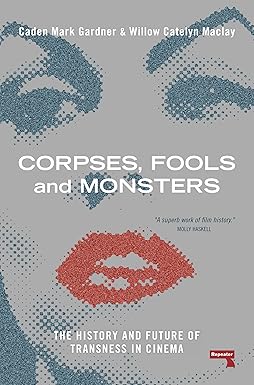
As mentioned before, many creative souls have taken on the history of the transgender experience in the cinema. That said, the new book Corpses, Fools, and Monsters: The History and Future of Transness in Cinema by Caden Mark Gardner and Willow Catelyn Maclay may very well prove itself to be the definitive guide on this subject. The book thoroughly explores the complex pathway of the depiction of non-gender conforming people on film through the decades. It is also a rigorous, detailed guide to dozens of movies which fall into this area of interest, from the obscure to the big budget Hollywood variety. Corpses, Fools, and Monsters includes the phenomenon of cross-dressing in films because, in the interest of “gender identity”, there has often been a relationship between the two (The Rocky Horror Picture Show, anyone?). The provocative title of the book comes from a 2018 episode of one of the authors’ series of discussions named Body Talk: “I don’t think movies are the be-all, end-all for social change or anything of the sort, but there’s certainly something symptomatic in the American psyche where for the most part the only times we’ve been on screen are to be murdered, turned into a joke, or a tragedy of failed transition. The mainstream isn’t interested in our livelihood or our goals. It’s a lost highway of corpses, fools, and monsters.” These are strong words indeed, but they are not at all hyperbole: As the reader learns in Gardner and Maclay’s book, the treatment of trans people in the cinema throughout history was at best patronizingly sympathetic (The Christine Jorgensen Story in 1970), and at worst outright hateful (Freebie and the Bean from 1974, in which the authors state, “The trans film image is intentionally malignant and negative.”). Sporadically, a transgender-themed movie or a movie with a predominant trans-associated character will make its way into the so-called “mainstream” consciousness, for better or for worse: Examples include Dog Day Afternoon (1975), The Crying Game (1992), and Boys Don’t Cry (1999). The authors diplomatically explore each film’s positive and problematic aspects, as well as their legacies on transgender film history (and, because the two are so eternally linked, film history at large). Of course, sometimes a movie’s legacy is VERY problematic. We’re talking about Dressed to Kill (1980) and Silence of the Lambs (1991), which indisputably bear the responsibility of shaping the negative stereotypes which are still employed by transphobic politics and individuals in 2025. It may seem absurd to also throw in a low-budget horror movie like Sleepaway Camp (1983) or a patently infantile comedy like Ace Ventura: Pet Detective (1994) into that same narrative, but it’s also impossible to deny the deplorable pop culture outcomes of those movies either. The authors avoid the trap of broadly labeling a movie as “good” or “bad” for the transgender image. An example of this is another movie which penetrated mainstream consciousness: Hedwig and the Angry Inch (2001), which the authors aptly describe as having a “complex” legacy. In another passage, the authors compare the movies Tangerine and The Danish Girl, both released in 2015 even though The Danish Girl received far more mainstream attention: “Tangerine was overwhelmingly favored by trans people in the year of its release, with a lot of that favorability rooted in its casting and the fact that its story felt authentic to the reality of a lived trans experience, while films like The Danish Girl came off fraudulent and cynical.”
Chapter 1 is devoted to Christine Jorgensen, who was not the first person to have gender affirmation surgery; however, her unique sense of celebrity made it certainly seem that way to many. As the book notes, she was indeed a pioneer in transgender representation and a global phenomenon. Jorgensen was, by all accounts, a “class act”, and the movie which was ultimately made about her life was arguably about as well-meaning as a movie of its time could be. However, Hollywood at the time seemed to find stories of “sex change” to be better told through an exploitative angle: Hence the now-cult-classic Myra Breckinridge in 1970, of which the authors observe, “Its transgressive quality as a novel drew people into making the film, but in execution Myra Breckinridge showed how Hollywood at the time could only muster a sense of pranksterism rather than earnestly devote any serious consideration in producing a trans film image.” The book progresses through the decades, with one chapter named David Cronenberg, Body Horror, and Empathizing with the Artificial Other, which enlighteningly explores movies which could be viewed as “trans coded” or “trans allegorical”. This chapter is no less than fascinating, as is the following chapter dedicated to the trans allegory known as… The Matrix franchise. Along the way, there are discussions of films which were clearly ahead of their time, such as The Queen (1968) and Paris is Burning (1990), which have enjoyed a well-deserved rediscovery among the younger generations. The book concludes on a promising note, mostly due to the fact that as transgender filmmakers and other artists create their own visions, a more realistic, well-balanced perspective of trans lives has emerged. But let’s go back to the past for a moment: Even the most devoted of cinephiles (like me!) will learn about new titles worthy of rediscovering, starting from the 60’s (I Was a Man, She-Man: A Story of Fixation, Queens at Heart); to the 70’s (Fassbinder’s In einem Jahr mit 13 Monden [In a Year of 13 Moons]); to the 80’s (Vera, Rosa von Praunheim’s Stadt der verlorenen Seelen [City of Lost Souls], which the authors describe as “joyous” and “a beautiful queer fantasia”.) These arguably “lost” films promise to only be more interesting and relevant in 2025 as ever before, even if for no other reason than curiosity and exploring LGBTQ history. It’s not just the movies themselves either; there are many personalities from history mentioned in this book whose stories are no less than fascinating. One of them is the 1970’s cult star Jennifer Michaels, whom the authors describe as “a recurring trans film image navigating the complexities of transition and sex work.” Other personalities include three Superstars of Andy Warhol’s Factory — specifically, Jackie Curtis, Holly Woodlawn, and Candy Darling. (The authors state, “Darling had an intoxicating Old Hollywood glamour that contrasted with the seedier New York art world she inhabited. Woodlawn was wildly expressive and had a profound sense of sarcasm and irony. Curtis, the most genderfluid and genderqueer, took cues from James Dean and was also the most mysterious of the trio.”)
By going in a chronological, intelligent, detailed yet smooth, and highly entertaining pathway, Corpses, Fools, and Monsters emerges as an essential entry into the study of LGBTQ history. It’s highly recommended.
Corpses, Fools, and Monsters: The History and Future of Transness in Cinema by Caden Mark Gardner and Willow Catelyn Maclay is available on Kindle and paperback at Amazon and other sites.
 LAVENDER AFTER DARK (because life begins when the sun goes down...)