
“Identities are fragile. Systems are fragile. Like eggs, all are functional… until they are not. ‘And all the king’s horse and all the king’s men couldn’t put Humpty together again.'”—Eric Bogosian
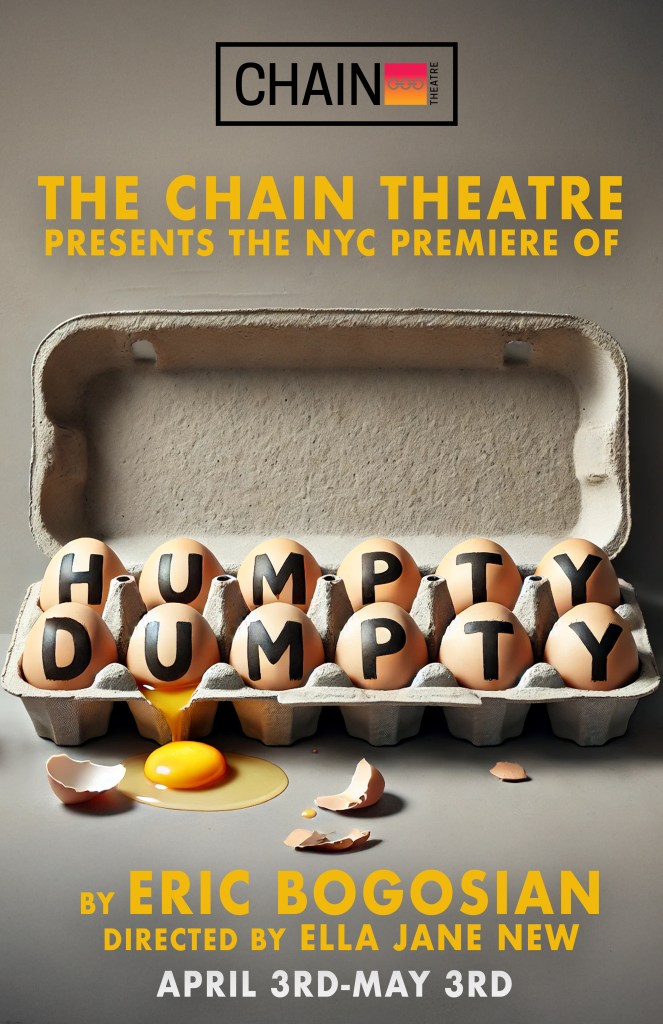
Eric Bogosian’s Humpty Dumpty, which the actor/playwright/novelist started writing 25 years ago, is currently making its New York City premiere at Manhattan’s Chain Theatre, with direction by Ella Jane New. Regardless of the time Humpty Dumpty takes place (Specifically, it takes place in the fall of 2000…), the play will indisputably succeed in packing an emotional punch to all tiers of its audience, regardless of their generation. The fears evoked in Bogosian’s piece can be an analogy for a number of historical events. September 11, 2001… The Northeast blackout of 2003… And, of course, the pandemic, when fear and isolation did some truly irreversible damage on the mental and emotional health of so many people. Regardless of how the audience relates to the story or the situations of its five characters, Humpty Dumpty is indisputably a hard-hitting piece of theater. That said, there are many smartly comedic moments throughout its 110-minute running time. When it’s funny, it’s REALLY funny. Still, at its core, Bogosian’s play is first and foremost a searing drama that escalates in its intensity right on to the last five minutes. It’s also a fearless expose of the human spirit– and just HOW MUCH gets “exposed” in times of challenge.
Humpty Dumpty takes place entirely in a single setting. That setting is a charming country house in upstate New York with a fireplace in every bedroom: a “five-hour drive” from the big, bad city. Married couple Max (Kirk Gostkowski), a novelist, and Nicole (Christina Elise Perry), a book editor, come to the house for a vacation. The Gothamites are joined by their friends from L.A: screenwriter Troy (Gabriel Rysdahl) and his girlfriend Spoon (Marie Dinolan), an actress. At first, it’s hard for this quartet to adapt to the so-called “simple life”. In one of those aforementioned comedic scenes, Nicole, Troy, and Spoon are all “talking business” on their (flip) phones at the same time, much to the annoyance of Max, who is eager to explore life “off the grid”. Considering that it was written in 2000, it is beyond prophetic how the play showed just how reliant upon wireless communication we’d become. (It’s worth mentioning at this point that there would turn out to be MANY prophetic moments in Humpty Dumpty…) If anything, as we know, reliance on our beloved “devices” has only gotten more pronounced as we enter the second half of 2025. It’s no mystery why the audience audibly reacted when one of the characters states, “You could live without a phone for a few days.” As it turns out, the first world inconvenience of poor cell phone reception is only the beginning…

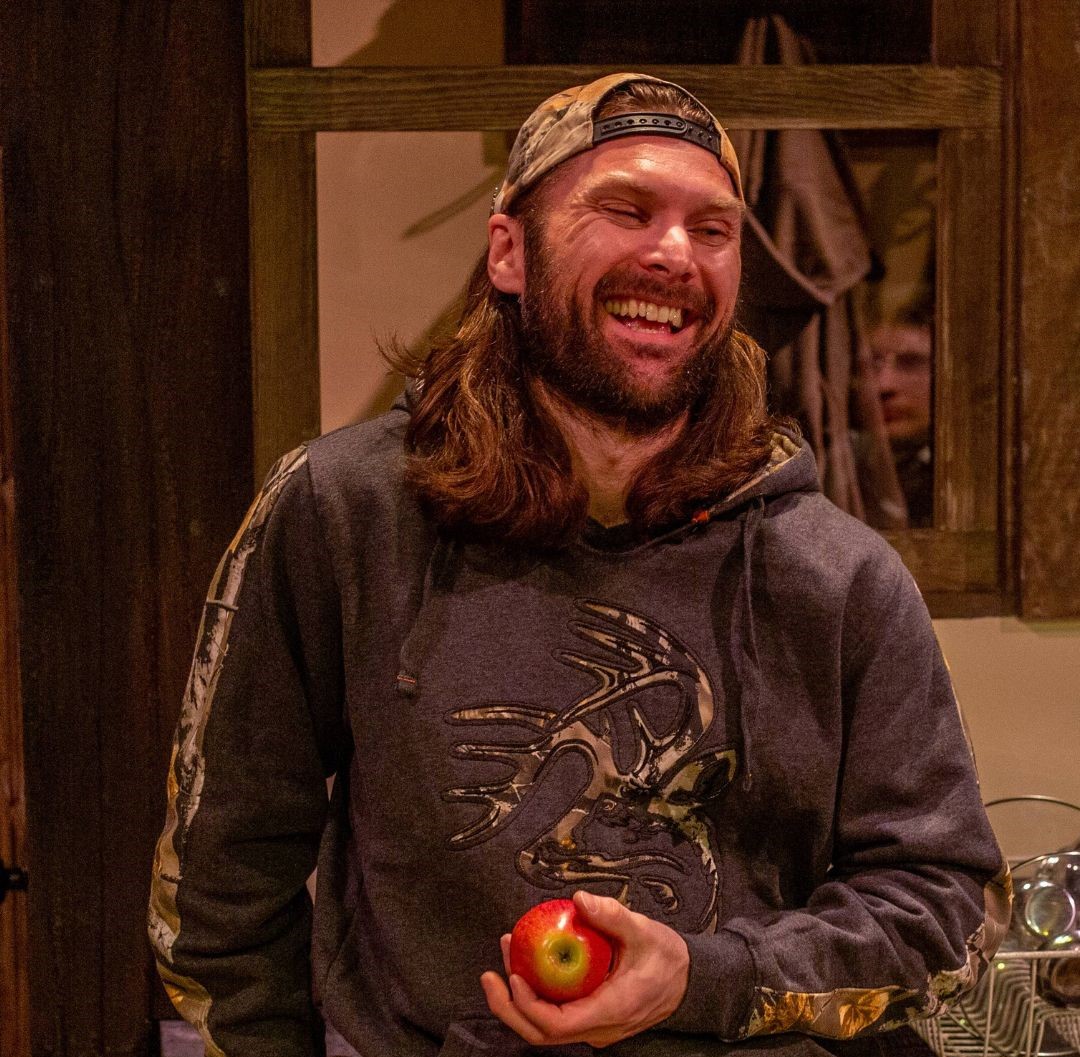
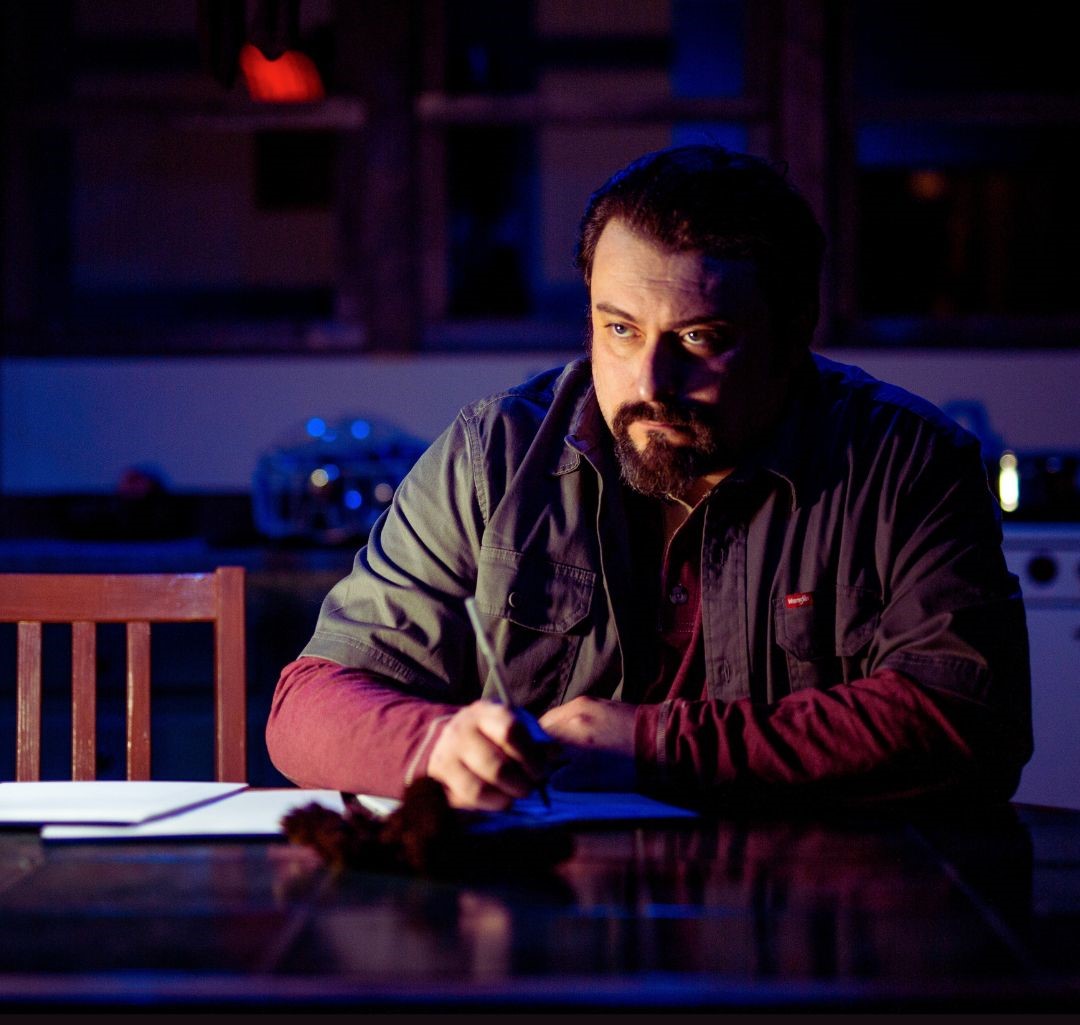
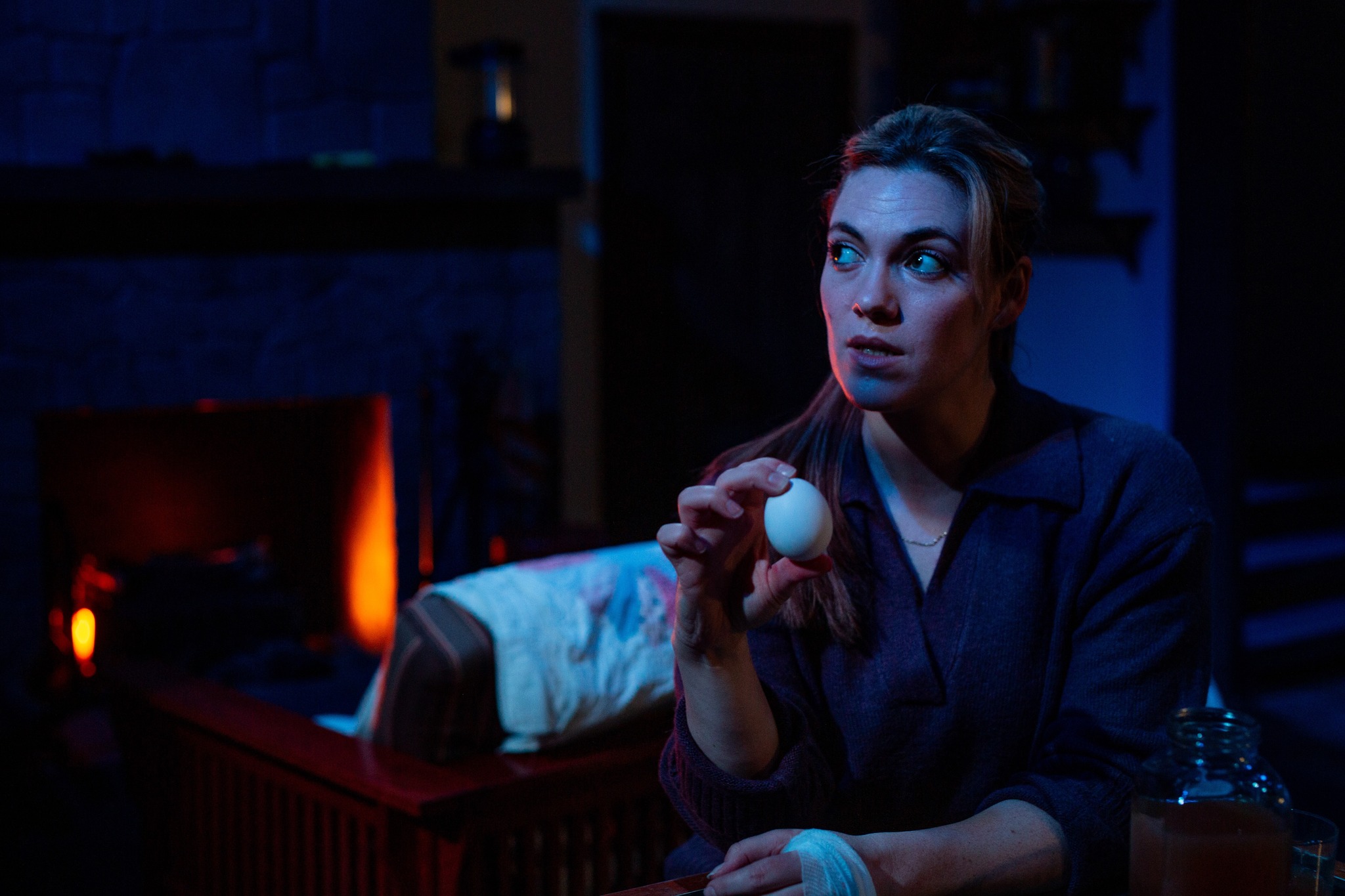
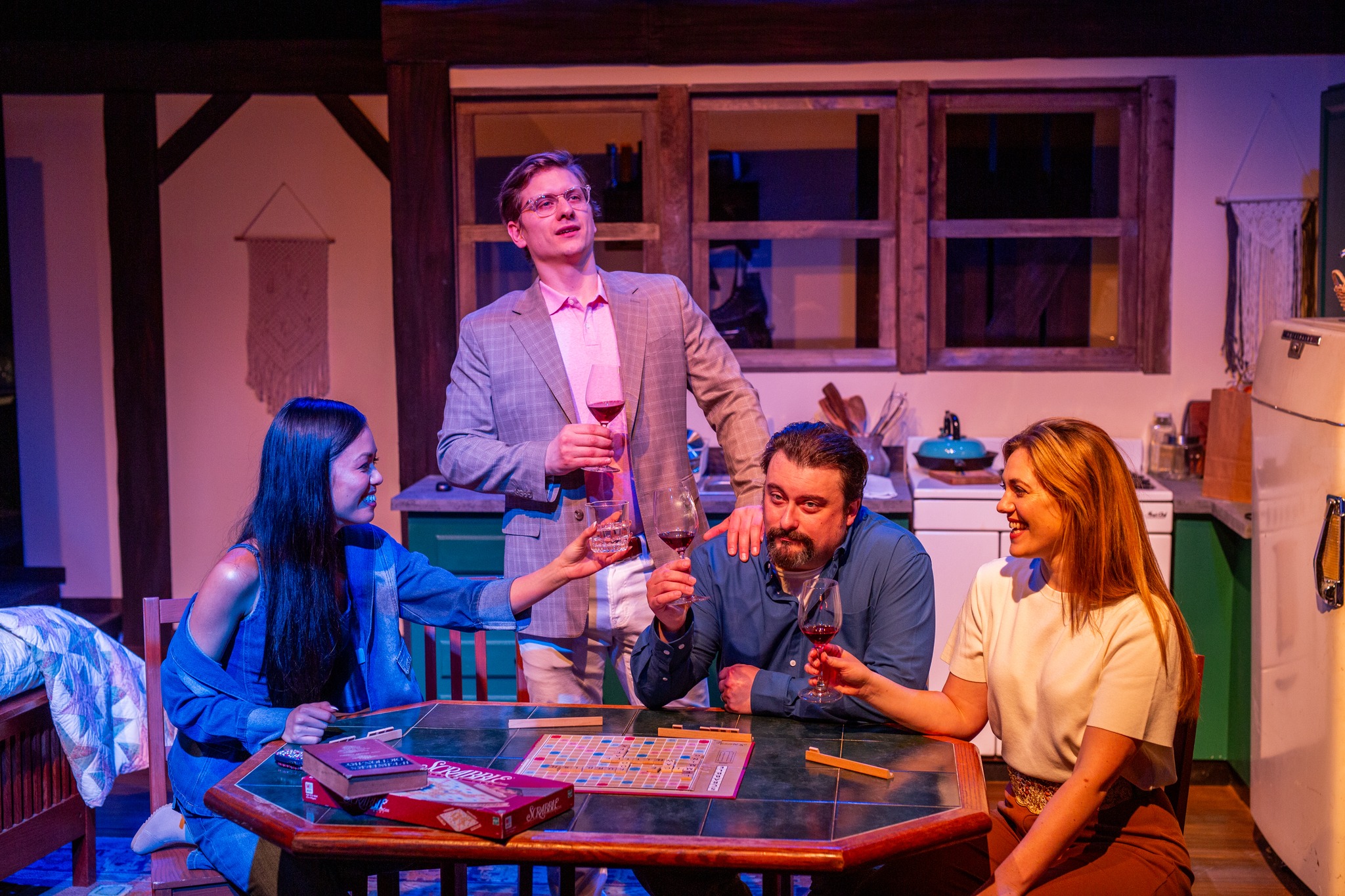
The “city mouse/country mouse” dynamic has always been a fruitful source of material for TV, movies, and theater. Had Humpty Dumpty taken on a more predictable “safe” pathway, it could have been a comedy of the four characters “roughing it” in a strange setting–that is, “roughing it” as best as these well-to-do characters could. Also predictably, the intimate space would no doubt force some secrets to be revealed between the two couples. Revelations do indeed come into light in Humpty Dumpty... but that’s only ONE facet of this play. The electricity unexpectedly turns off, and that occurrence colors the entire story; It turns out NOT to be just a matter of a “fuse box”. The mental and emotional health of all four friends is put to the test, both as a group and individually. An example is the character Troy, who at first comes across as a harmless, even laughable, “snob” who speaks condescendingly of the local population– but whose subsequent deterioration into mental cruelty towards Spoon can be hard to watch. By Act 2 of Humpty Dumpty, the seriousness of the characters’ situation is much more pronounced– and, to the credit of the playwright, the actors, and some small but highly effective changes in set design and lighting (courtesy of David Henderson and Michael Abrams)– the audience feels like they’ve weathered the effects of the crisis as much as the characters on the stage. In contrast to the two couples is the house caregiver Nat, who has lived in a rural atmosphere his whole life and is more able to cope with the still-unknown threat in the region. Nat is a rare character in the New York City theater culture; an authentic but largely unseen everyman that city-dwellers (real or fictional) will most likely NEVER come across in their lives. Nat is perfectly played by Brandon Hughes; he’s definitely NOT a caricature or a broad foil to the urbanites. In fact, while the play’s depictions of the unseen upstate natives (shorthanded as “hippies and hillbilles”) may seem scarily exaggerated to the point of being heavy handed, the deconstruction of overprivileged urbanites (ie: the movers and shakers of New York City and L.A.) is no less brutal. Given the body of work of the playwright, I have no doubt that these characters– as well as the characters who we never even see on stage– are based either entirely or largely on real people.
The acting in Humpty Dumpty is excellent. Nicole and Troy and are savagely portrayed by their respective actors Christina Elise Perry and Gabriel Rysdahl, although we still believe every minute of their characters. As Spoon, Marie Dinolan is a standout as the most sympathetic figure out of the five. As Max, Kirk Gostkowski gets to play Humpty Dumpty’s arguably most nuanced and complicated character, perfectly balancing his seemingly innate actor’s intensity. Most impressively, by the play’s conclusion, the mood created by the playwright and the actors transform the space into one that’s V-E-R-Y different from the opening. Hell, the audience never even learns the fate of one of the four friends. Thus, there emerges a SIXTH, unseen “character”: the omnipresent fear of the unknown. And this unseen sixth character makes its presence very felt.
Eric Bogosian’s Humpty Dumpty, directed by Ella Jane New. continues at the Chain Theatre Main Stage, 312 W. 36th St, 3rd Floor, NYC, through Saturday, May 3. Visit Humpty Dumpty — Chain Theatre for tickets and more information.
(Photos by Matt Wells.)
 LAVENDER AFTER DARK (because life begins when the sun goes down...)