
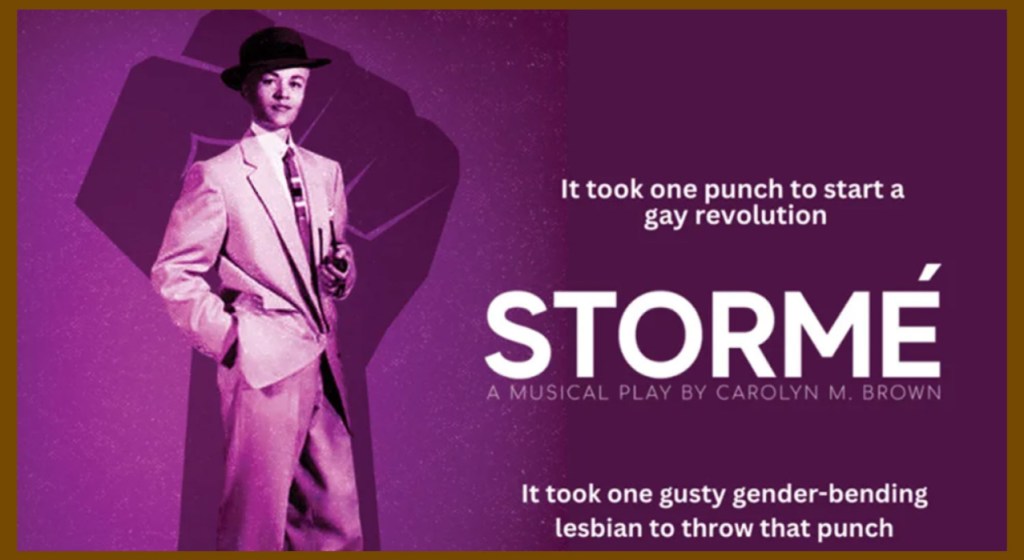
Stormé DeLarverie, who passed away in 2014 at the age of 93, was one of the true unsung heroes in modern American LGBTQ history. She was a visible presence in the New York City queer community, particularly in the West Village, far into her later years; Many people of a certain age, including those of us who “came out” in the formative 1990’s, still vividly remember her and speak of her fondly. DeLarverie indisputably deserves the same recognition as such other renegade LGBTQ rights pioneers as Marsha P. Johnson or Sylvia Rivera. However, her name is arguably not as readily identifiable as those aforementioned icons. STORMÉ, the intense, important new musical play written by Carolyn M. Brown and directed by Kevin Davis, is one step in the pathway to change that. The play gives its audience a lot of fascinating insight on the person who was much, much more than just “the butch lesbian who threw the first punch at Stonewall”. Yanece Cotto plays the titular Stormé, and she is absolutely wonderful in the demanding role. But in her script, Brown also makes sure to insert a great deal of much-needed LGBTQ history into the piece. Stormé DeLarverie’s true life story is more important than ever before.
Today, the Stonewall Inn is known as a national landmark, tourist attraction, and enduringly popular nightlife venue which welcomes all members of the LGBTQ community and their allies. However, as STORMÉ the musical reveals, Stonewall is most definitely NOT the same place it was in 2025. In the 60’s, it was not fancy by any means. (As one character sarcastically notes, “No one comes here for top shelf liquor!”) Still, it was a haven for the LGBTQ community. As Cotto’s Stormé points out, Stonewall had two dance floors “for people like us”. Same-sex affection was allowed. That said, the fear of danger– specifically, police raids– was always in the air. One character commented, “Corralling queer people is a great way to boost arrest records. We’re easy targets.” She forebodingly added, “We don’t resist…” (More about that later…) Via flashback and with enough ambition and attention to detail to rival any Broadway show, Brown’s musical looks back at the woman behind the lore: an unapologetically out and proud queer woman, a talented performer, and an ardent fighter for LGBTQ equality in the face of the unrelenting racism, sexism, economic disparity, and homophobia through the decades. STORMÉ opens in 1992 at Henrietta Hudson, an iconic lesbian bar in New York City’s Greenwich Village. Ms. DeLarverie, now 72, is still working as a no-nonsense bouncer (or “well-paid babysitter”, as Stormé calls it), dealing with obnoxious men who try to gawk at the bar’s clientele and even worse. Licensed pistol in pocket, she’s protective of “her girls” and clearly as tough as nails. But DeLarverie has a tender side as well: Without missing a beat, she hands Carlos, an AIDS activist, $2000 in cash as a donation to his new organization. The scene not only brings a piece of DeLarverie’s well-deserved legacy to life, but the audience is treated to a mini-history of lesbian bars in New York City as well. (This scene, FYI, is only one of many scenes which educate the audience about queer history. More about that later…) Lesbian culture, for the most part, has been largely underrepresented in the theater, so this segment is actually very welcome. The play then proceeds to showcase Stormé’s life, from her time as a young woman from New Orleans who traveled to Chicago and then New York City to find her career as a singer. Later, she would find an even more enduring role as an LGBTQ activist. It was a life of thrilling highs and tragic lows– but, as the audience learns, even the highs were colored by the assorted prejudices at the time– which STORMÉ the play decidedly does NOT shy away from.
STORMÉ briefly brings the audience back to the New Orleans of Stormé’s childhood; We learn that she was the daughter of a white father and a black mother. She left fled the South to find success in Chicago (“Singing is my only love.”). One of the first things she found, however, was a kindred spirit: an openly gay composer named Billy Strayhorn, AKA “Sweet Pea” (played perfectly by Antonyio Artis). A gifted singer, she established herself in an elite circle of performers, being gal pals with the likes of Sarah “Sassy” Vaughn, Billie Holiday, and Dinah Washington. She even formed her own band. Unfortunately, despite the success, she also faced unrelenting racism. In one scene, the club owners tell Stormé (who they believed was white) that she can eat in the dining room, but that her band (who are unmistakably men of color) couldn’t. Eventually, the singer found her way to Harlem, New York City, where she became a sensation, both on stage and behind the scenes, with the Jewel Box Revue at New York City’s famous Apollo Theater. Stormé was a drag king at a time when it was still a rare art form, hence the iconic image of the star which most audiences know her from today. Still, her arguably biggest role– as LGBTQ activist– was still ahead, and it’s well displayed in the play’s climactic Stonewall Rebellion scene where the riots went on for a whopping FIVE days.
In the role of the larger-than-life Stormé DeLarverie, Yanece Cotto is a revelation, slowly transforming from a nervous neophyte of a singer to a tough matriarch to the LGBTQ community. Cotto is a fine singer, as is Antonyio Artis as Billy Strayhorn. The play gives them both a chance to show their musical talents. Josh Boyce plays “Billy Dae”, a Billie Holiday-inspired drag queen, complete with Ms. Holiday’s signature gardenia in her hair. Boyce sings in his own voice, bringing equal doses of fabulousness and fun to his character; His St. Louis Blues became an audience clap-along. The play explores Stormé’s 25-year relationship with dancer Diana. Diana is played by Asha Devi, and the chemistry between Devi’s Maria and Cotto’s Stormé is very entertaining to watch. The two are so opposite in personality, but yet also so satisfyingly complimentary. The energetic, hard-working supporting cast of Sean Segerstrom, Aidan Martinez, Jenna Lucht, Iain McLellan, and Zoe Hunter are all wonderful playing multiple roles throughout the play, with Segerstrom particularly entertaining as the character “Danny Brown” in the end of the first act. Lucht plays a character named “Ginger Snaps”, whose glass breaking voice gave the audience a much-needed dose of levity. Cat Gillespie does a fine job dealing with the MANY set changes, especially given the intimate space of the American Theatre of the Actors. The production is bolstered by a dynamic playlist of period music, from eternally beloved tunes like Sweet Georgia Brown, Ain’t Nobody’s Business and Get Happy to several original musical pieces. Speaking of music: Musical Director Nicholas Sienkiewicz deserves a huge shoutout for his tireless job as pianist, providing live musical accompaniment throughout the show.
As mentioned before, the play gives a great deal of time and detail to the LGBTQ struggle through the decades, and how it often went hand-in-hand with the fight for racial equality– although, as the play explores, it wasn’t always a smooth alliance. Throughout the play, such historical figures and places as Hazel Scott, Gladys Bentley, Adam Clayton Powell, Marsha P. Johnson, The Mattachine Society, Daughters of Bilitis, Julius Bar, and many others are mentioned; All of these are worthy of further study. It may seem difficult for the younger generations to understand that mass raids of gay bars were commonplace at one time. The scenes of police brutality are rough to watch and would seem gratuitous if it were not for the fact that all the prejudice and violence depicted in STORMÉ is based on real history. Even today, so much of LGTQ acceptance is often dependent on what political force is in power at the time, which STORMÉ the play explores several times. And even Stormé herself knew that the forces of good, equality, and justice would ALWAYS eventually triumph, despite the constant fight against adversity. It’s more relevant than ever as we enter Pride 2025
As part of Jay Michaels Global Communications ICONS Festival, STORMÉ continues at The American Theatre of Actors, 314 W. 54th St. New York City, NY 10019, through Sunday, June 15. STORMÉ is made possible with support from The NYC Women’s Fund for Media, Music and Theatre by the City of New York Mayor’s Office of Media and Entertainment in association with The New York Foundation for the Arts. Show running time is 2 hours with a 10-minute intermission.
Show contains strong language and sensitive subject matter. For tickets and more information, visit STORMÉ – American Theatre of Actors.
 LAVENDER AFTER DARK (because life begins when the sun goes down...)