
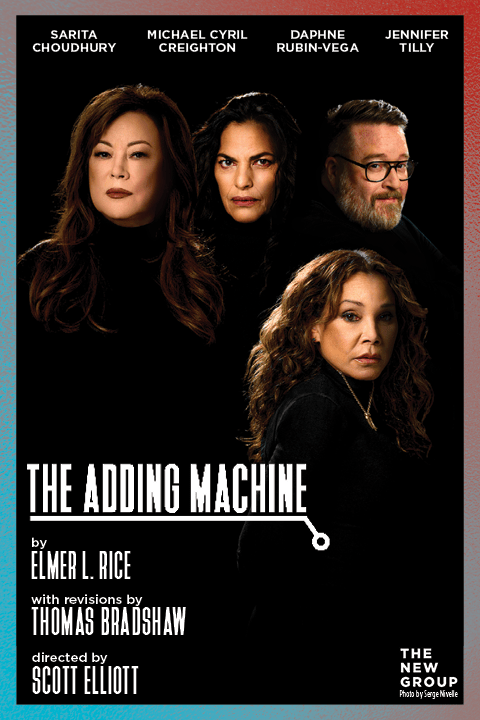
The Adding Machine, a black comedy from playwright Elmer Rice, was originally written and performed on Broadway in 1923. The characters in Rice’s play are VERY much emblematic of their time period, at least in terms of their assigned gender- and culture-based roles… and seen from a 2026 lens, that’s NOT always a positive thing, as the audience soon learned. However, the author himself has long been regarded as having been ahead of his time and even quite prophetic. The first feeling that came to my mind after watching The New Group’s lively, renegade, and highly entertaining new production of The Adding Machine, now playing at New York City’s The Theater at St. Clement’s and directed by Scott Elliott, was curiosity. I was curious about how the author’s peers would have reacted to his somewhat alarmist vision of the future of American society when he first presented this play. In The Adding Machine, it’s a future in which technology is rapidly replacing humanity, and we have even reached the point where humans have traded names for numbers. For example, our main character, a 50-year old accountant, is named “Mr. Zero”. Later on, party guests are only known as “Mr. and Mrs. 2, Mr. and Mrs. 3, Mr. and Mrs. 4”, etc…
The inciting incident in this truly unique theater experience is when Mr. Zero learns that after 25 years of service (and without ever missing a day at work, as he frequently reminds us…), he will be replaced by the titular “adding machine” of the title– for financial reasons, natch. This leads to an unapologetic murder, execution by electric chair, and a trip to the afterlife. But more about that later…
Historical significance and unique plot notwithstanding, the main calling card of this incarnation of The Adding Machine is indisputably its cast. These are four actors with widely diverse career trajectories: Sarita Choudhury, Michael Cyril Creighton, Daphne Rubin-Vega, and Jennifer Tilly. In the role of “Mrs. Zero”, Tilly kicks off the very first lines of dialogue as her nightgown-clad housewife lies in bed, ready to call it a night. Even though Mr. Zero is in lying in bed right next to her, there isn’t really a conversation going on: The husband barely says a word. It’s actually a monologue from Mrs. Zero, where the sexually frustrated wife gives her negligent, thoroughly disinterested husband a very thorough verbal takedown. It’s brutal, but also riotously funny thanks to Tilly’s comically shrill delivery. Ms. Tilly is perfect in the role; I’ll jump ahead a bit and say that she gets a generous share of the play’s funniest moments. It is also during this first scene that the audience realizes that the near-silent husband, Mr. Zero, is actually played by Daphne Rubin-Vega in male drag. While it may seem strange to envision the lovely Rubin-Vega playing a male character, she is excellent in this role. Intentionally or not, this unorthodox casting adds some humor (albeit a very different kind of humor than Ms. Tilly’s aforementioned over-the-top campiness) to a character which, given Mr. Zero’s oft-unsavory persona, would more likely provoke equal parts pathos and scorn from the audience.
In the next scene, the audience learns that Mr. Zero doesn’t have much better luck at work: He’s stuck in a monotonous job, adding numbers by hand day in and day out. If there’s a bright spot, it’s his pretty, single co-worker Daisy (Sarita Choudhury), who has a secret crush on Mr. Zero. After being replaced by the titular adding machine, Mr. Zero’s long-gestating rage gets the best of him. He murders his boss (Michael Cyril Creighton) and gets sent to the electric chair– but not before a visit from the ahem, “grieving” Mrs. Zero. This gives Jennifer Tilly yet another chance to steal the scene. Mr. Zero finds himself in a purgatory of sorts, identified as “Elysian Fields” by a mysterious character named “Shrdlu” (also played by Creighton). Daisy, who took her own life after Mr. Zero was executed, is also there. The pair finally get to express their suppressed feelings for each other. This moment actually gives Choudhury her chance to shine. The actress is perhaps best known from her role in three seasons of And Just Like That, where her character Seema is a no-nonsense, confident, independent, and sophisticated career woman. In this play, Choudhury’s character Daisy, dancing around barefoot in a slip, evokes an idealistic, dreamy-eyed 18-year old. Rounding out the cast is Michael Cyril Creighton, who is indisputably the connective tissue in this piece: In the program, he is listed as playing “The Boss and everyone else”. That “everyone else” includes the narrator, the boss, and all the “party guests” mentioned in the first paragraph. Watching Creighton play all the “party guests” must be seen live to be fully appreciated! It’s worth mentioning that some past productions of The Adding Machine have used multiple actors to play all of these characters, which makes Creighton’s performance of multiple roles even more impressive. Later on in the show, while in the “afterlife”, yet another of Creighton’s characters delivers a monologue to Mr. Zero, in which he absolutely “tells it like it is” to our already beleaguered protagonist. The ending is heavy, but it’s guaranteed to have a lot of conversations L-O-N-G after the curtain call. Despite the many moments of humor– both dark and over-the-top, courtesy of Ms. Tilly– The Adding Machine raises some serious issues. Do we, as human beings, deliberately sabotage our own happiness? Is there really such a thing as “the American dream” anymore?
The Adding Machine is indisputably dated in some moments: Mr. Zero’s character’s casual racism and sexism, for example, is disquieting to observe. That said, the piece is eerily more relevant than ever as we approach the midway point of 2026. (Can you say “AI”?)
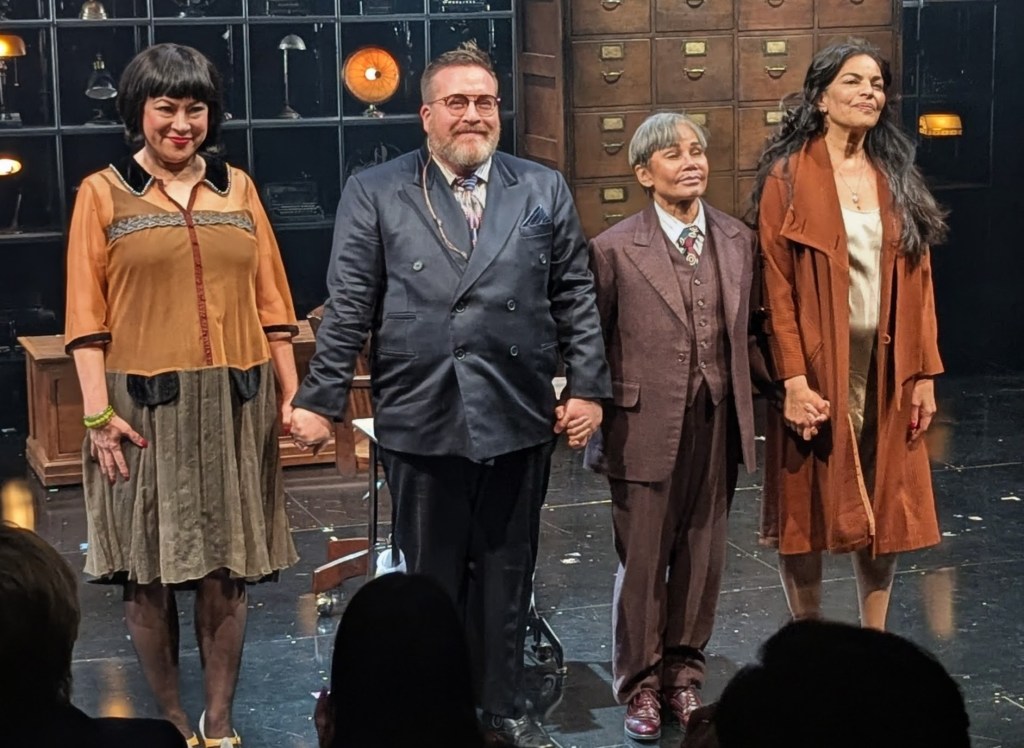
The New Group’s The Adding Machine continues through May 17, 2026 at Theatre at St. Clement’s, 423 W. 46th St, NYC. . Visit here for more information and tickets.
 LAVENDER AFTER DARK (because life begins when the sun goes down...)