
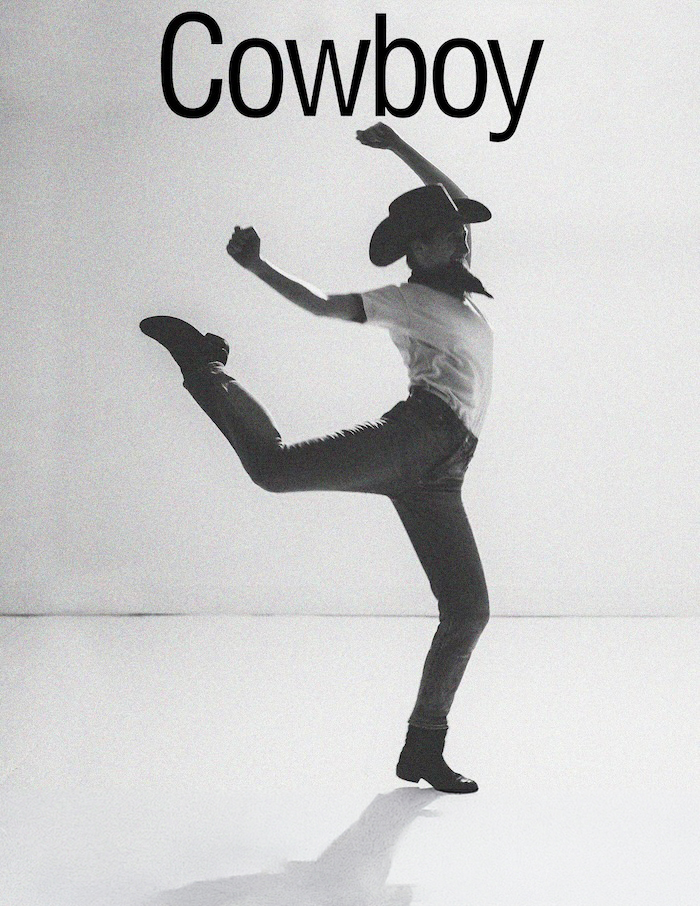
Cowboy is the sophomore production by New York City-based interdisciplinary performance group Harlow Radical. Via our titular character, this ambitious, highly entertaining (mostly) solo piece explores the legacy of one of the most popular and enduring of American archetypes: As you may have guessed, the enduringly iconic “cowboy”. The ample-sized stage of The Royal Family Performance Arts Space became a fine showcase for the performance skills of its actor Kendal Hartse. Cowboy is simultaneously simple and complex, humble and grand, quiet and explosive. The show features a wealth of movement adorned by music, expert scenic and lighting effects– and a distinctly minimal use of spoken word.
Cowboy will renew any audience member’s faith in the art of movement: not just the art of dance, but the art of movement in a broader sense. Hartse’s ability to move her body is no less than astonishing. This may be a one-person show, but the actor has the skill and energy of an entire cast. A distinct shout-out must be given to the awe-inspiring scenic design (by Nora Marlow Smith) and lighting design (by Victoria Bain). At several points in the performance, Hartse dances with two silhouettes of herself, with all three figures competing for dominance. It’s an effect that reminds us of the power of live theater, without the need for digital trickery or overly elaborate technology: AI be damned! The sound design (by Mike Ekelburg) also deserves accolades: Even in the distinct absence of music or background noise (AKA “the sound of silence”, perhaps with the random call of a horny coyote…), the results are spot-on.
But to backtrack a bit: Just how iconic is the cowboy? Well… if a child or adult puts a ten-gallon hat on their head, a wild rag around their neck, and boots (preferably with spurs!) on their feet, then voilà— instant “cowboy”. But the cowboy culture and lifestyle are far, far more than a “costume”: It is very real and still very present in modern day America. The cowboy and American popular culture (AKA film and music) have always walked hand-in-hand: The opening track of Cowboy– My Rifle, My Pony, and Me, famously performed by Dean Martin and Ricky Nelson in the 1959 western Rio Bravo— exemplifies this from the beginning. That said, many most depictions of cowboy culture were not always realistic. Too often in works of fiction, the lifestyle was overly glamorized or romanticized. Could this be any more obvious than in metaphor-heavy lyrics like “I will weep like the willow, that weeps in the valley. I’ll be lonesome until you return.” from In the Valley by Marty Robbins? As Hartse dances frenetically to Hollywood-style upbeat music in some moments of the show, the camp value of what we are watching is perfectly exemplified by Hartse’s painted-on smile– as if the performer knows that millions of adults and kiddies alike will be watching that Pepsodent smile on a huge Technicolor screen and is totally “in on the joke”. As much as these Western-themed cinematic fantasies– complete with that oh-so-familiar music– hold up when we watch them on TV today, it’s difficult to approach them in anything but a tongue-in-cheek fashion as we enter the last four months of 2026. Through its unnamed main character, however, Cowboy also explores the less flashy aspects of the lifestyle: including but not limited to enduring the harsh elements of nature, loneliness, and the intense physical strain on the body. Need we be reminded that starting a fire back then required rubbing two sticks together?
The Wild West, with its rigidly defined gender roles, may have indisputably been a man’s world– even if solely for the severely skewed ratio of men to women in America’s colonial days. (The concept of “importing” women from France in the movie Paint Your Wagon was indeed based on fact.) Yet in a testosterone-heavy, so-called “traditionally” masculine world, the piece adds a much-welcomed female perspective when Hartse transforms from the titular cowboy to a Wild West saloon girl plying her trade at the local watering hole. Transformation via costume notwithstanding, it’s hard to believe that this “lady” is played by the same actor. Every bump and grind in her character’s act is classic burlesque, and her performance truly puts the “tease” in the art of striptease– a phenomenon that may have been lost for a while, but thankfully is being reclaimed in the new wave of neo-burlesque performers.
As mentioned before, the cowboy lifestyle has always been side-by-side with popular culture. Thus, Cowboy is adorned by many transgenerationally familiar tunes: specifically, the music of Marty Robbins, Ricky Nelson, Eddy Arnold, Chet Atkins, Charles Mingus, Miles Davis, and Aaron Copeland. Of course, you can expect to hear My Darling Clementine…
Cowboy had a brief performance run in New York City. Let’s hope that the piece comes back for another go-round soon!
Harlow Radical’s Cowboy is directed by Austin Regan, and is choreographed by and stars Kendal Hartse. Ginger Hurley is assistant choreographer. Follow Harlow Radical on Instagram @HarlowRadical.

