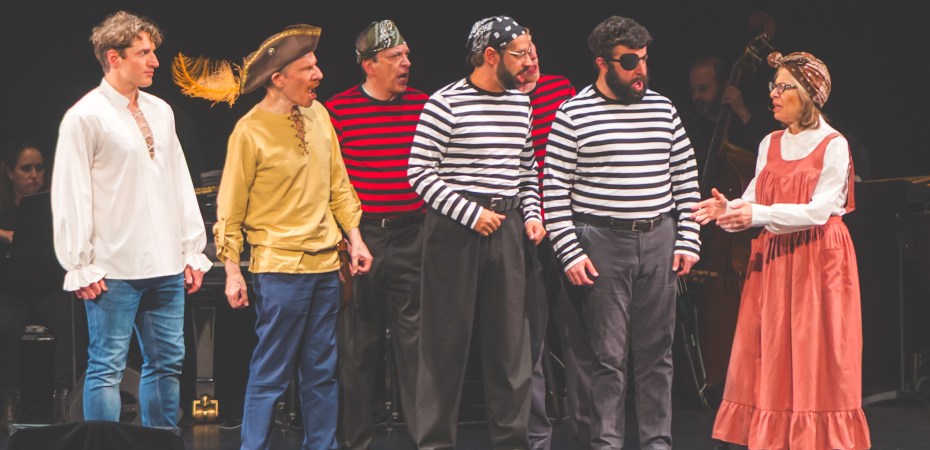
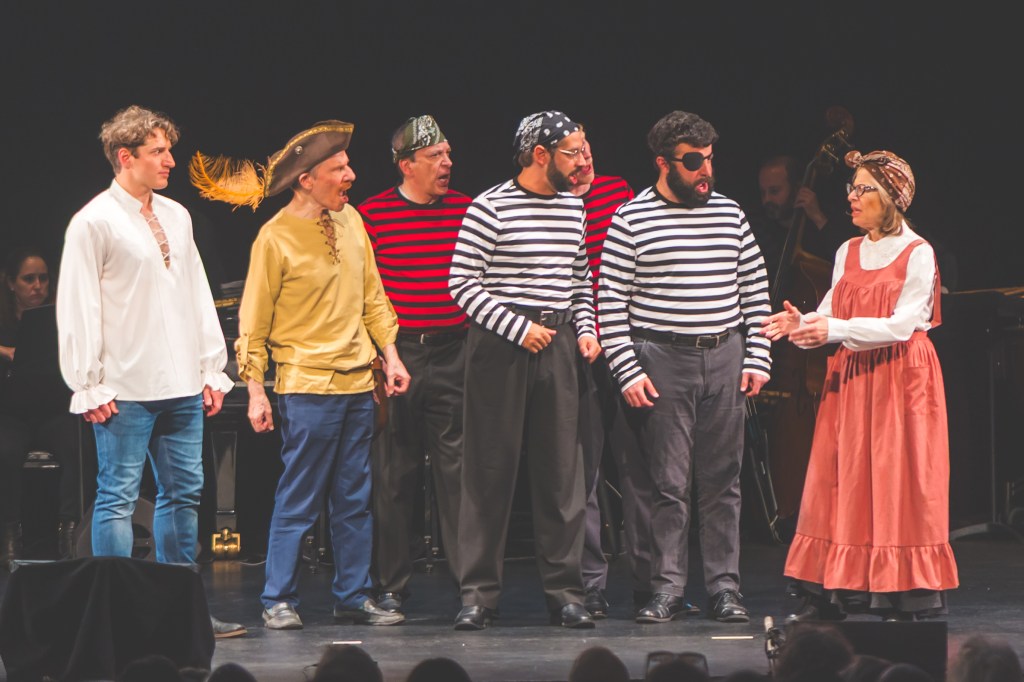
On Sunday October 25th, the National Yiddish Theatre Folksbiene (NYTF) treated two sold-out houses at New York City’s famous Symphony Space to Di Yam Gazlonim, its adaptation of Gilbert and Sullivan’s Pirates of Penzance in Yiddish. The show was directed by Allen Lewis Rickman, who also stars as The Major-General/Der Groser General. Given the enduring cultural omnipresence of Pirates, most recently with a Broadway revival in 2025, it’s hard to believe that the original musical was first performed in New York City in… 1879! Throughout its 146-year history, the musical has experienced many new interpretations and incarnations. But make no mistake: Whether you are a hardcore Pirates fan or have never even seen the show; or whether or not you don’t (or THINK you don’t! **) understand a single word of Yiddish, this production is no less than delightful.
Di Yam Gazlonim was first created in 1988 by Al Grand, a Gilbert & Sullivan devotee and Yiddish translator. So often, Broadway superfans mirthfully wonder how one of the show’s most popular songs, I Am the Very Model of a Modern Major General, would sound when translated; in fact, that was the most common question I was asked after I shared that I saw this show. It helps to understand that Grand’s version is a free adaptation rather than a lyric-by-lyric translation, preserving Gilbert’s rhymes and Sullivan’s musical structure while reimagining the story in Yiddish. And, while we are on the subject, Allen Lewis Rickman’s Ikh Bin der Groyser General that evening was indeed a standalone production-within-a-production: an astonishing combination of comedic skill and singing talent, particularly when one of his daughters requests him to sing “Faster, Daddy!” (He does!). This number was indisputably the audience’s favorite moment of the show. Di Yam Gazlonim is also heavily imbued with a seemingly infinite number of Jewish cultural references throughout. So… while those who have seen Pirates of Penzance in one of its past forms may remember the salty men singing about the joys of being a pirate, they may not remember lyrics like “Pass the whiskey! Pass the wine! Give us bagels and seltzer. It’s a regular party!”. In THIS theatrical voyage, those delicious words make perfect sense, as does when Rickman’s Der Groyser General declares, “Cheer out loud for Jewishness!”.
But let’s start at the very beginning… In a way, Di Yam Gazlonim has at least some of its work cut out for it. The oh-so-familiar songs from the original musical sound every bit as lively and funny as they likely did back when the show was first performed. This is evident from the very beginning with the familiar overture, the one so often used in commercials for the show through the decades (As a child of the ’80’s, I can verify that the inimitable theme REALLY stays with you…). This may be a good time to acknowledge the orchestra, conducted by Musical Director Zalmen Mlotek, who also was pianist. This team has the gift that every orchestra strives for: As a group, their synchrony is no less than perfect. But the audience can still hear each instrument on its own as well; every musician gets to showcase their talent. Needless to say, the orchestra continued to work very hard throughout the remainder of the show.
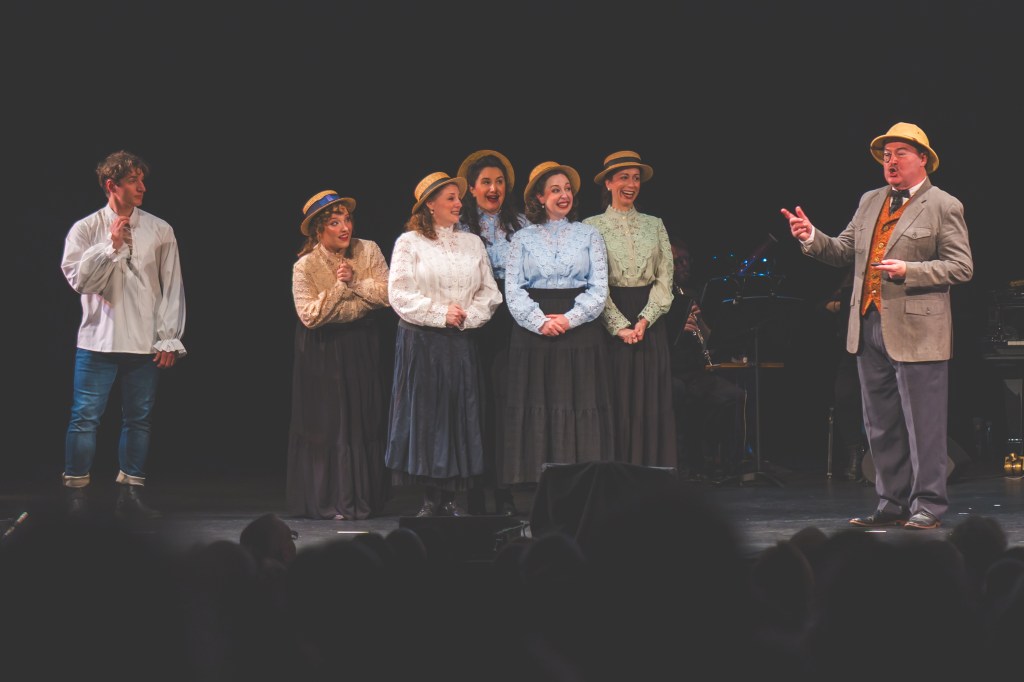
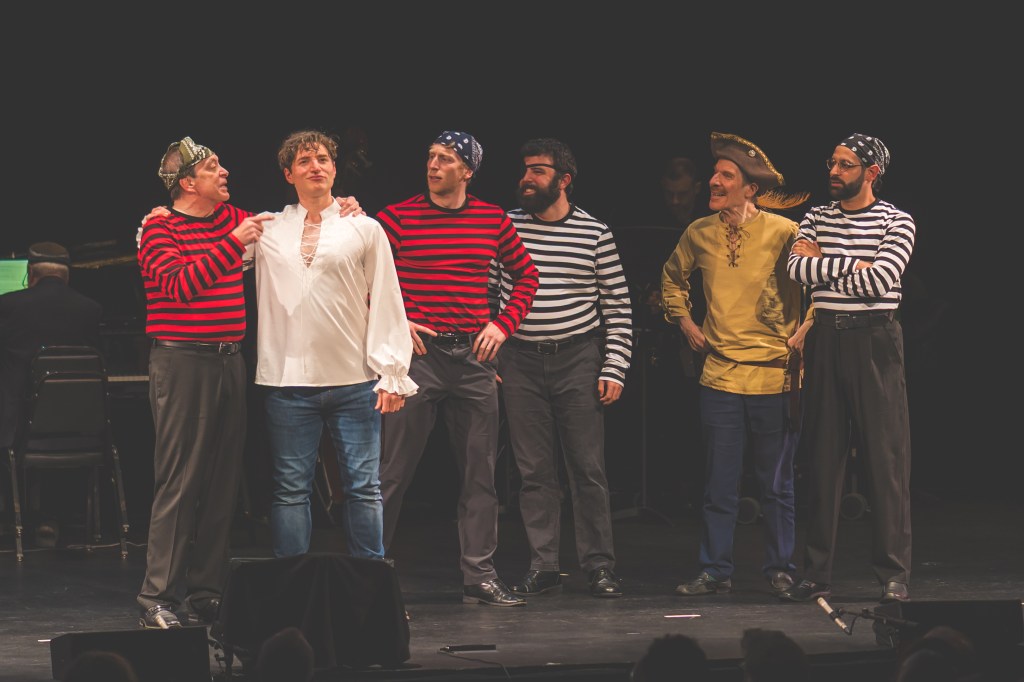
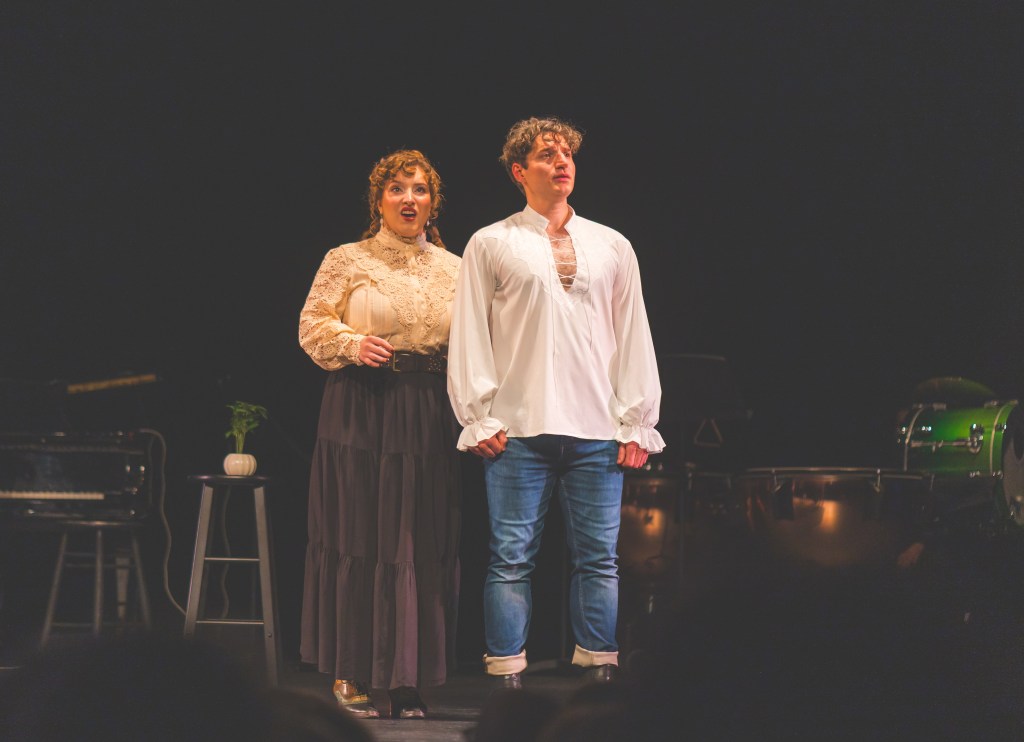
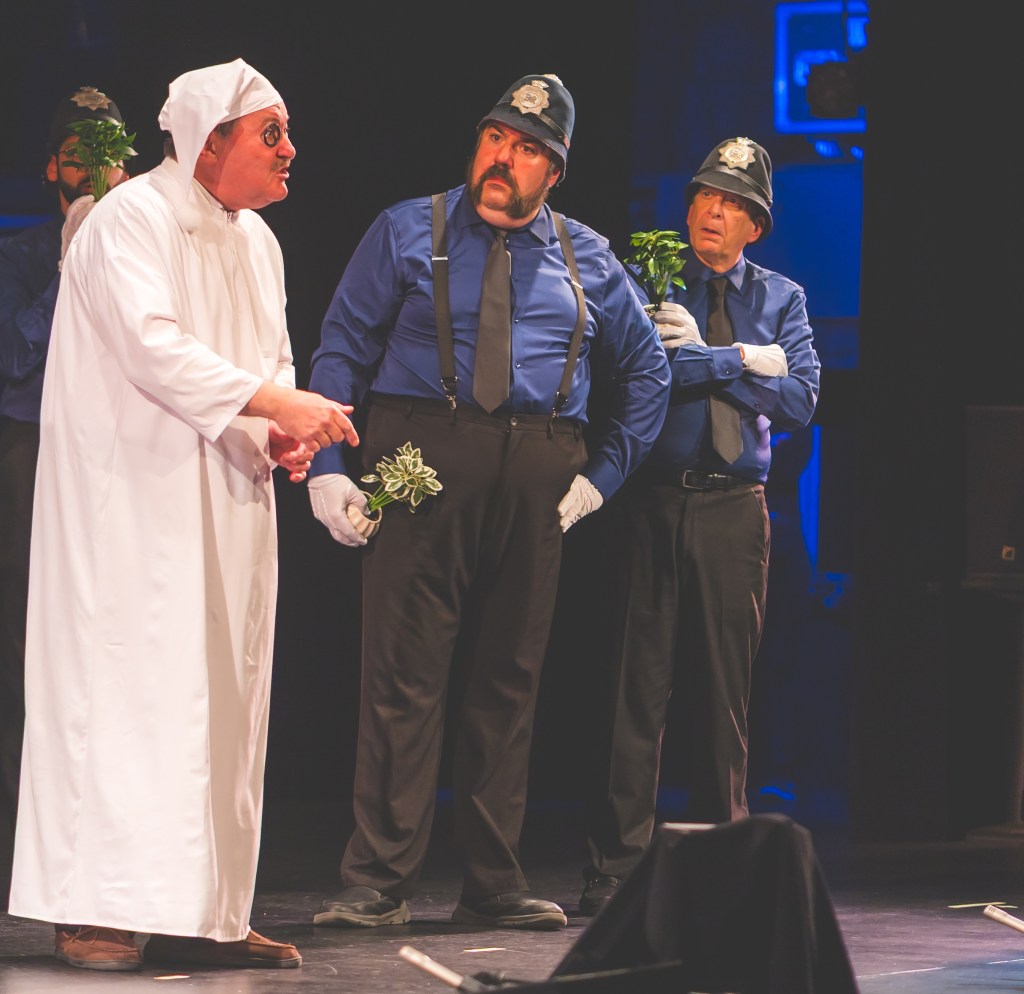
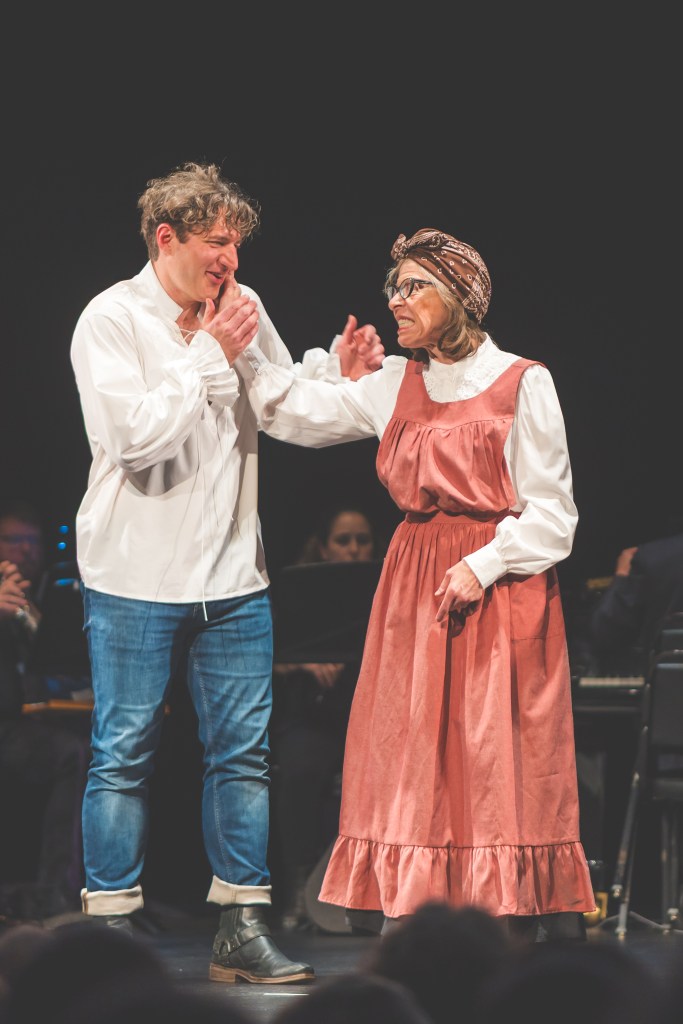
Underneath the production’s humor, musical talent, and Jewish cultural significance, there IS a story! Favyl (Drew Seigla), is an apprentice of the Pirates of Penzance Zhitkovits. Having just turned 21, he has just “graduated”. The only woman in his life up until now has been his mother figure, Rivke (Jackie Hoffman), who has also reluctantly played housekeeper for this brotherhood of six pirates. While on land, the seamen come across a quintet of sisters (“lovely flowers of a Jewish garden”), who resist the hirsute charms of these bad boys. (How could they turn down partying with this fun party of pirates? Oh well… !) Regardless, Favyl contemplates leaving his fellow bandits for a more respectable lifestyle when one of the sisters, Malke (Annabel Parker), steals his heart. He even envisions a group wedding, complete with chuppah. However, it’s not that easy: The girls’ father is the Major-General (and a good Jew, too!) who pleads with the pirates not to take his daughters; He is an orphan too, he tells them. However, the pirates soon learn that he is NOT an orphan, and they vow revenge. The police, led by their Sargeant (Adam B. Shapiro), can’t seem to bring much law and order to the situation. I won’t give too much of the ending away, but I will say that true love conquers all– and as it turns out, the pirates aren’t really “villains”; they are just “misunderstood”. (Yes, the show was W-A-Y ahead of its time!) I will also add that the final “revelation” in the show’s last 10 minutes received a huge wave of laughter from the audience, which was almost identical to the reaction when I had first seen this show in New York City in 2006.
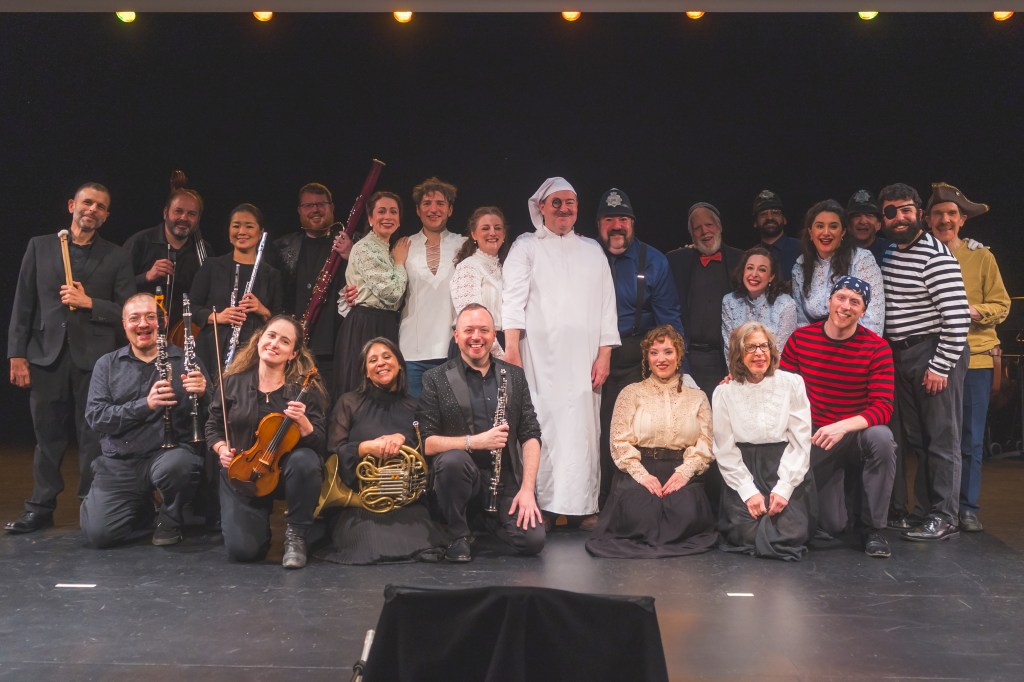
The entire cast is excellent. The actors playing the pirates (Bob Ader, Kirk Geritano, Eli Mayer, John Reed, and Steve Sterner) have wonderful chemistry together. Similarly, the actors playing the sisters (Ashley Adler, Hannah Madeleine Goodman, Stephanie Lynne Mason, and Yelena Schmulenson) perform in joyous harmony, even as they sing patently corny songs. (“It’s a lovely day to hop down the hills, run ’round the rocks, traipse by the trees…!”) As the protagonist who should have just stayed in Yeshiva, Drew Seigla is wonderful as Favyl. As Malke, Annabel Parker is a revelation, giving the audience some of the show’s most impressive singing notes, particularly in Avu Iz Do A Meydl Sheyn/Umgliklekher. Favyl and Malke’s love song Fayvl Bist Azoy Sheyn, in which the couple vow to wait 63 years to be reunited, is enough to renew anyone’s faith in L-O-V-E (in any language…) As Rivke, Jackie Hoffman steals every scene she’s in– not only with her trademark deadpan humor, but also with her accomplished vocal range, which may be surprising to those who know the star mainly from movies and TV. Speaking of comedy… In a show with no shortage of humor, Adam B. Shapiro’s blend of expertly clownish physical comedy and lyrics to match was undisputedly the whimsical highlight of Di Yam Gazlonim.
Some of the lyrics had me wondering if I was missing something: Favyl scolds Rivke with“You sold me WOLF COOKIES, you big cheater!” “Wolf cookies”?! Also, this may be the only musical in existence to have the word “elephantiasis” in the lyrics. (Hit me up if you know another…). By now, you may be wondering if you need to know Yiddish to enjoy this production. But hey: Great music, great humor, and great talent transcends language, and so…
**You do NOT need to understand Yiddish to enjoy this show. The audience, in fact, really found a lot of humor in the fact that so many Yiddish words have made their way into our modern-day lexicon, at least in New York City: Who, for example, doesn’t know what a “mensch” is? One song in Di Yam Gazlonim even has a song called, appropriately enough, A Mishegas which uses the word “mishegas” over and over again– and I’ll testify that the audience laughed EVERY time they heard that word. For this song, “mishegas” is translated into English as “poppycock”.
Let’s hope these “Pirates” come ashore again in the near future!
National Yiddish Theatre Folksbiene’s Pirates of Penzance/ Di Yam Gazlonim was directed by Allen Lewis Rickman, with Musical Direction by Zalmen Mlotek, Libretto translated by Al Grand, Adapted book and additional materials by Allen Lewis Rickman. The cast was Jackie Hoffman as Ruth with Bob Ader, Ashley Adler, Kirk Geritano, Hannah Madeleine Goodman, Stephanie Lynne Mason, Eli Mayer, Annabel Parker, John Reed, Allen Lewis Rickman, Adam B. Shapiro, Yelena Shmulenson, Drew Seigla and Steve Sterner.
(Photos by Properpix.)
See more at National Yiddish Theatre Folksbiene

