
“Truth is what I want to impart to you as we begin our journey together. Truth is what we seek. It is the only thing that genuinely matters… ”

Those are among the first words we hear in The Totality of All Things, the highly provocative and highly entertaining drama written by Erik Gernard. Presented by UP Theater Company, the award-winning play enjoyed a run at 154 Christopher Street Theater, directed by Shannon Patterson. The setting is a high school in the small town of Lewiston, Indiana (Population: 6,405.) in the fall of 2015. The words are spoken by Judith Benson (Colleen Clinton), a blunt-spoken, no-nonsense teacher and committed advisor to The Broadcaster, the high school’s award-winning newspaper: She has her aspiring student journalists make a pledge to seek that oh-so-important truth in their future writing endeavors. Most importantly for the inciting incident of The Totality of All Things, the speech takes place only two months after the Supreme Court’s legal recognition of same-sex marriages in the United States.
Lewiston, Indiana is described as a town with “one stop light and half a Dairy Queen.” It’s the kind of small town so often utilized (and so often romanticized) on both the stage and on screens big and small: a setting where everyone seemingly knows each other– and knows everyone else’s business as well. An early scene is an example of that: Three friends and fellow teachers (Judith, DeeAnn, and Gregg) meet up for the town’s Friday night football game, which is established early on as the center of Lewiston’s social life. The audience soon learns that these three friends and co-workers have quite different political views: Judith is the self-proclaimed “lone wolf liberal” in the town. DeeAnn (DeAnna Lenhart) is Judith’s bestie– and as such, she vows that she will stand up for her liberal friend even as she states, with deadpan sincerity, that Obama was born in Kenya and, later on, declares, “There are no gay people in Lewiston!” Gregg (Joseph Dean Anderson), a teacher at the high school and likely a lifelong resident of the tiny town, tries to maintain some sense of neutrality via his likeable, “All-American” persona. Rounding out the group is Ms. Carter (Logan Floyd), a student teacher who is slowly adjusting to her new professional and social surroundings. The differences in political opinions among the friends and co-workers, it turns out, are symbolic of a larger culture war which was seemingly waiting to happen…

As mentioned earlier, the The Totality of All Things takes place only a couple of months after the landmark national marriage equality case. To commemorate the occasion, Judith adorns the bulletin board in her classroom with clipped-out articles and photos of the social phenomenon. The innocent bulletin board subsequently throws the town into chaos– and someone spray paints a swastika over the display board. Principal Benson (Rik Walter) goes into “damage control” mode with canned statements like “Let’s not escalate this more than it already is.” Judith enlists one of her most promising students, Micah (excellently played by Cody Jenison in a standout role), to cover the event, which many politely try to downplay as “the unfortunate incident in Room 107.” Having mostly focused on art, the young man with an endearing affinity for big, SAT-style words, is reluctant to do this, but he eventually yields. While The Totality of All Things starts out (and continues) as a sensitive, character-driven (small town) “slice of life” drama, the play also soon becomes a mystery as well: Who defaced the bulletin board? And why?
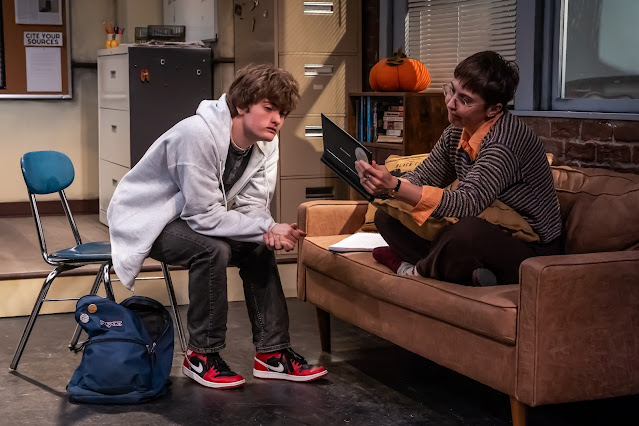
The act of vandalism has long-reaching effects, not the least of which is the threatening of the friendship between Judith and DeeAnn. On a larger level, the incident divides Lewiston into two camps, complete with agitating social media posts. In the meantime, Micah’s deep dive into finding the identity of the vandal opens up his own personal Pandora’s box of emotions. And while she is willing to stand up to Principal Benson, the town, and even her own ostensible allies, the audience wonders if Judith will pay a price for her unyielding principles. If so, was that price worth it? Eventually, the identity of who defaced the bulletin board with a swastika is revealed, but not before many revelations come to light and many emotions are heightened into full overdrive. The final moments of Gernard’s play are no less than explosive.

All of the performances in The Totality of All Things are excellent. A true ensemble piece, playwright Gernand gives all six characters the chance to have their moments. As the central character, Judith Benson doesn’t necessarily come across as a sympathetic figure. That said, she is neither a complete villain nor an absolute heroine. But then again, this is a story without easy answers. Colleen Clinton is perfect in the role. Likewise, DeAnna Lenhart is equally skilled playing an equally complicated character who acts as an ideological rival for her friend Judith. She is also often very funny in the role. That said, most of the humor comes from Logan Floyd, who is a revelation in their portrayal of Ms. Carter. Joseph Dean Anderson and Rik Walter are superb as Gregg and Principal Benson respectively.

The Totality of All Things packs a lot into its running time. Beyond its main plot, many important secondary themes are explored, including the under-respected role of teachers and the politics of small-town American life. It is always provocative and often very funny, but it’s never heavy-handed. The piece may take place in 2015, but history would prove the story to be quite prophetic: The events depicted in the play come across as a precursor to a society where American political views have become even more rigid, and where despite any individual’s attempts to “stay neutral” or “avoid politics” in their daily lives, their attempts seem to be, at best, frowned upon– and at worst, 99% impossible in 2026. Like the central character, playwright Gernand knows that his plea for equality is on the right side of history– and while every character “has their say” in his play, the author never waivers in his mission solely for the sake of maintaining so-called “neutrality” to try to please everyone. (Hint: This NEVER works!). A priceless example of this comes in a conversation between Gregg and Ms. Carter: Gregg decares “Life isn’t always black and white.”, to which Ms. Carter responds, “Except the times when it IS!” This reviewer couldn’t agree more!
The Totality of All Things is highly recommended theater.
UP Theater Company’s The Totality of All Things is written by Erik Gernand and directed by Shannon Patterson. Assistant Director: Em Walter. Production Stage Manager: Sophia Flynn. Set Designer: Scott Aronow. Lighting Designer: Shane Hennessy. Sound Designer: David Margolin Lawson. Costume Designer: Sofie Daley.
Photos by Mike Chiodo.
 LAVENDER AFTER DARK (because life begins when the sun goes down...)