
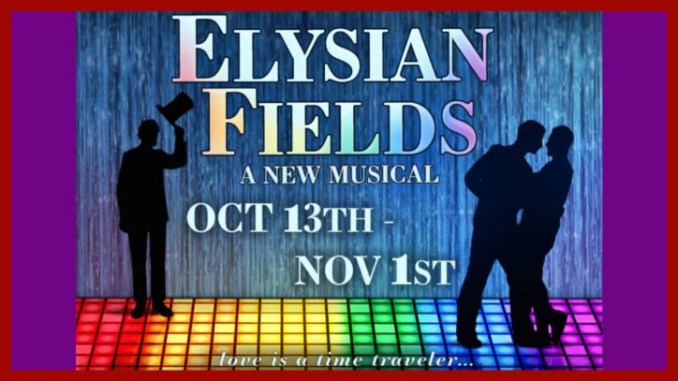
Ambitious, smartly conceived, and historically important, Elysian Fields is a grand new musical by Steve Fisher and Marc Fliedner, with direction and choreography by Andrew Coopman. Elysian Fields is making its World Premiere at New York City’s American Theatre of Actors. The musical explores the love story between Abraham Lincoln (played by Harrison Drake) and Joshua Fry Speed (played by Alexander Ullian), which has often been ignored, severely downplayed, or angrily denied throughout history. In parallel fashion, the play also uses a dual timeline structure to transport us to Louisville, Kentucky in 2016 to tell the very modern and more-relevant-than-ever love story of civil right attorney “Abe” and hardware store owner “Josh” (also played by Drake and Ullian respectively). Lest we forget, 2016 was the year when same-sex marriage was legally recognized for the first time in all 50 states– yes, even Kentucky, as one of the characters notes. Elysian Fields isn’t the first time that Lincoln’s sexual orientation has been explored in theater or film– but this provocative musical may prove to be the definitive exploration of the subject, thanks to its attention to historical detail, its respect for its characters (both past and present), and outright audience appeal. The play features a large, diverse cast, many standout musical numbers, and many important messages about equality. Without jumping too far ahead, I’ll state that Elysian Fields is indisputably a Broadway-quality production on a distinctly off-Broadway stage.
In Greek mythology and religion, the “Elysian Fields” are the final resting place of the souls of the heroic and the virtuous. For two men in American history– sixteenth President of the United States Abraham Lincoln and planter/businessman Joshua Speed– “Elysian Fields” was also a euphemism for something else: something special but definitely NOT mythic. It was a place where two men in love could express their feelings without apology or shame. For Lincoln and Speed, this wasn’t even “the love that dare not speak its name”; This love didn’t even HAVE a name. There was no commonly used term to describe a relationship like that at the time, although the oblique description “intimate friendship” seems to have been the, ahem… “polite” term that was preserved in history through Lincoln’s own letters to Speed. Unfortunately, due to the rigid rules social norms imposed by American culture at the time, anything implying “L-O-V-E” between these two men could never have been stated, leading Lincoln to use the term “this peculiar misfortune both yours and mine“. The future President even speculated whether their love could even be “legitimized” 100 or even 1000 years in the future… In the very first scene of Elysian Fields, set in February 14, 1866, Mr. Speed is unveiling a statue in the likeness of “Kentucky’s greatest son” on what would have been the President’s 57th birthday. Speed had commissioned the statue.
But before you can say “Yours forever“, Elysian Fields magically fast forwards to the modern-day Blue Moon Kentucky Club. It’s President’s Day Weekend, and these patrons know how to party. This night features the musical talents of “Dell & The Blue Ball Boys” and is hosted by the club’s larger-than-life MC and LGBTQ mother figure Black-Eyed Suzie (Anthony Wayne). The theme of this night is “PILF” (“Presidents I’d Like to Fuck Find [on the Dancefloor]”), where attendees are encouraged to dress like their favorite presidents, veeps, and first ladies from throughout history– a fabulous idea in itself. (Watching Hillary and Kamala get down together on the dance floor is worth the price of a ticket alone…) Between the all-out music and Black-Eyed Suzie’s charms, it’s enough to make the audience jump on stage and party with the cast– or at least get up and dance in the aisles. The show’s first two songs– the hi-NRG inspired Love is a Time Traveler and the bluegrass Black-Eyed Suzie— are unabashed audience pleasers. But it’s not just about fun. This is an educational event, boys and girls! Black-Eyed Suzie is hosting trivia, where both the participants of the bar (and the audience) get to know some titillating facts about President Lincoln, such as the well-documented fact that Honest Abe and Mr. Speed shared a bed for four years. The bar scenes, as well as the parallel party scenes pf the 1800’s, are a delight to watch. With a live band and so many performers on the relatively small stage at once, the result could have been chaotic… but the director/choreographer gets it right. This night at the Blue Moon is also a very special one for Abe Kaplan and Josh Reddy, two young men who are getting married. Height difference notwithstanding, Abe and Josh are well-matched but still have some personality differences. Abe is a Jewish transplant from New York City, and he is dealing with anxiety. His “Louisville knight” Josh is more “salt of the earth”, and he is politically conservative. Josh is also particularly adept as assuaging Abe’s anxiety, and less inhibited with showing affection: At one point he serenades his fiancée with I’m Marrying You for You, a funny and oh-so-sweet love song. (If this song doesn’t become a new wedding anthem, then there’s no justice in this world.) Adding to their differences is family drama. Abe’s mother Judy (Franca Vercelloni) is not overly excited about her son’s upcoming marriage, not only because son is marrying a man but because that man is a Red Stater. It’s in contrast to Josh’s flashy, overwhelmingly supportive mother Brenda (Madison Merlanti), a popular local singer. Like the men’s modern-day counterparts, Lincoln and Speed also had their personal differences and challenges. When the pair first meet in 1837 at Speed’s General Store, the men are sharing an innocent conversation about Lincoln buying a new bed. However, it’s strikingly obvious that there’s sexual tension simmering below the surface.Lincoln and Speed alsohave some differences in political philosophy, most glaringly when it comes to the issue of slavery. True to societal norms, both men are expected to marry: socialite Miss Mary Todd (played excellently by Melanie Gertzman) is armed with a dowry and a goal of marrying a future President. Likewise, Speed is expected to uphold those aformentioned socitel norms by marrying Fanny Henning.
Act 1 of Elysian Fields cumulates with the wedding day of Abe and Josh. Unfortunately, Abe’s size 14 feet turn cold, and he runs off leaving the heartbroken Josh at the chuppah. Will the pair reunite? Will the two men eventually get the proverbial happy ending that their spiritual counterparts from the 1800’s never got to enjoy? The audience finds out in Act 2, but not before Abe and Josh address some serious issues… and, of course, many more musical numbers.
For one number, Deep River, the play explores parallel aspects of American freedom (LGBTQ equality and slavery) when Lincoln and Speed discuss their personal situation while four performers (Kobe Brown, Jaymi Horn, Evan Michael Smith, and Anthony Wayne) solemnly sing about the African American experience. It’s one of the most provocative moments of the show, bolstered by the vocal talents of the four singers.
In a story about love through the centuries, there’s a LOT to love in Elysian Fields. Harrison Drake and Alexander Ullian are both supremely talented singers, with each having their own moments to show that talent. Intentionally or not, the two performers often have moments of trying to “one up” each other for musical dominance, resulting in something of a heated rivalry. Their chemistry as Abe and Josh (and Abraham and Joshua) respectively is very palpable. When the two men dance (In the “rationale” of Joshua teaching Abraham how to dance before his upcoming wedding to Mary Todd), it’s a small but feverishly romantic moment which expertly symbolizes their “forbidden love”. There are many more standout performances, including Gertzman’s long-suffering Mary Todd Lincoln, Franca Vercelloni’s Judy, and Madison Merlanti’s Brenda. As Black-Eyed Suzie, Anthony Wayne steals every scene he’s in, right down to the details of Suzie’s gold sequined microphone… and, without giving away too much, this diva saves the day. Suzie’s number Honor the Grace deserves to become a new classic for LGTBQ quality and respect for pioneers of the movement. That said, the entire ensemble cast has their moments. Seeing ReW STaRR and Elizabeth Rose as gossiping gals at a White House party is a guilty pleasure. Ethian Mathias has a pivotal (and, as mentioned before, very relevant) scene in Act 2 as a teenager kicked out of his house, who finds a new home and an adoptive family at the Blue Moon. The music is a mix of high energy audience clap-alongs, moving ballads, and many numbers where the cast get to really sing their hearts out (Yours Forever, I Don’t Love Me, Fool of the Town, and more). This cast and the live band of Elysian Fields are working their butts off– but like the characters they play at the Blue Moon Kentucky Club, they always look like they are having fun, especially during the dance numbers.
Elysian Fields is an unambiguous plea for equality– but via the family dynamics of its two main characters, the play discourages people to simply “take sides” or to follow blind allegiance to their political party. Instead, it reminds all of us to focus on the concept of honoring the freedom of two of their fellow Americans to legalize and celebrate their love for each other. And, hopefully, future lovers will no longer have to wait 179 years for that freedom…
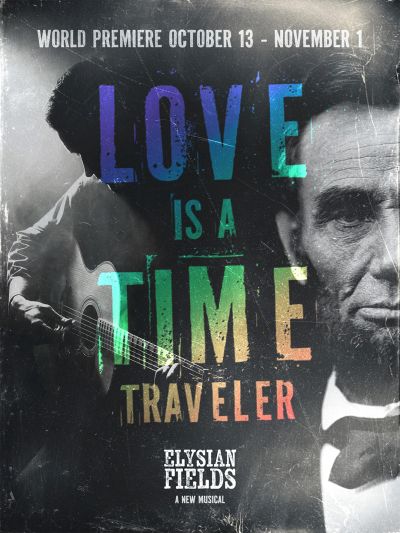
Elysian Fields continues through Sunday, November 1 at The American Theatre for Actors, 314 W 54th St, New York City. For tickets and more information, visit www.ElysianFieldsMusical.com.

